
When law enforcement gathers evidence in a criminal case, they have to play by the rules. But what happens when they don't? That’s where a critical legal tool called a motion to suppress evidence comes into play.
A motion to suppress is a formal request filed by an attorney asking a judge to throw out certain evidence, preventing the prosecution from using it at trial. It's not about arguing guilt or innocence—it's about ensuring the government followed the Constitution.
Defining the Motion to Suppress Evidence
Think of it like a referee throwing a penalty flag in a football game. If a team scores a touchdown after an illegal play, the points don't count. The same logic applies here. If police obtain evidence by violating someone's rights, that evidence can be deemed inadmissible.
This motion focuses entirely on the process—how the evidence was collected—not what the evidence itself claims to prove. It's a powerful check on law enforcement's power.
The Core Purpose of This Motion
The main goal is simple: to stop the prosecution from using illegally obtained evidence to convict a person. This protects individual rights in the immediate case and also serves as a strong deterrent, discouraging law enforcement from cutting constitutional corners in the future.
The motion is grounded in fundamental protections, most often the Fourth Amendment, which guards against unreasonable searches and seizures. It forces the court to act as a gatekeeper, ensuring that only evidence gathered fairly and legally makes it in front of a jury.
To better understand what a motion to suppress evidence involves, let's break down its essential components and objectives in a simple table.
Core Components of a Motion to Suppress
| Component | Purpose and Explanation |
|---|---|
| Legal Filing | A formal written request (the "motion") submitted to the court before trial, outlining the specific evidence in question and the legal reasons it should be excluded. |
| Constitutional Basis | The argument is almost always rooted in a violation of constitutional rights, such as an illegal traffic stop, a search without a warrant, or a coerced confession. |
| Focus on Procedure | The motion challenges the methods used by police to gather evidence, not the evidence itself. The key question is, "Was this obtained legally?" |
| Exclusionary Rule | This is the legal principle that makes the motion work. It states that evidence obtained illegally ("fruit of the poisonous tree") cannot be used in court. |
A successful motion can completely change the landscape of a criminal case. When key evidence is thrown out, the prosecution’s case can crumble, often leading to reduced charges or even a full dismissal.
Ultimately, this motion is a vital safeguard. It reinforces the principle that the ends do not justify the means, ensuring that a conviction can't be built on a foundation of misconduct. It's a cornerstone of what makes the justice system fair in Georgia and across the United States.
The Constitutional Foundation for Excluding Evidence
At first glance, the idea of throwing out perfectly good evidence seems counterintuitive. If the police found something that points to a crime, why would a court ever refuse to look at it?
The answer goes all the way back to the bedrock of American freedom: the Fourth Amendment to the U.S. Constitution. This isn't just some dusty legal phrase; it's a powerful shield designed to protect every person from government overreach.
This amendment guarantees the right to be secure in person, home, and property against "unreasonable searches and seizures." In plain English, it means the police can't just stop someone, search their car, or barge into their home on a whim. They need a legitimate reason, known as probable cause, and in most cases, they need to get a warrant from a judge first. A motion to suppress is the legal tool used to call them out when they cross that line.
What Makes a Search "Unreasonable"?
So, where is the line between a reasonable search and an unreasonable one? While it can get blurry, centuries of court cases have helped define it. Generally, a search is considered unreasonable if it happens without a warrant, without probable cause, or without valid consent.
Think about it this way: getting pulled over for a broken taillight doesn't give an officer a blank check to start rummaging through an entire car. If they decide to pop the trunk and search bags without a warrant or another specific, legally sound reason, that search would almost certainly be deemed unreasonable.
The Fourth Amendment acts as a critical boundary between the government's power and an individual's right to privacy. It ensures that investigations are conducted based on evidence and suspicion, not on hunches or arbitrary decisions.
This protection is the entire foundation a motion to suppress is built on. Without it, there would be no legal grounds to challenge how the police collected evidence. That brings up the next logical question: what actually happens when this fundamental right is violated?
The "Teeth" of the Fourth Amendment: The Exclusionary Rule
If the Fourth Amendment is the shield, the Exclusionary Rule is the sword that gives it power. This is the legal doctrine that puts teeth into constitutional rights and makes them matter in a real-world criminal case.
Simply put, the Exclusionary Rule says that any evidence the government obtains through an illegal search or seizure cannot be used against a defendant in court. It’s the legal system's way of saying that evidence tainted by a constitutional violation is inadmissible. This is often called the "fruit of the poisonous tree"—if the search (the tree) was illegal, then any evidence found (the fruit) is poisoned and must be thrown out.
This rule isn't just about ensuring fairness in one person's case; it serves a much bigger purpose. Its main job is to deter police misconduct. By taking away the incentive for law enforcement to cut constitutional corners—knowing that any evidence they find illegally will be tossed—the rule encourages them to follow proper procedures and respect every citizen's rights.
This principle became the law of the land nationwide in the 1961 landmark Supreme Court case Mapp v. Ohio. Since then, it has been a cornerstone of criminal defense, ensuring that the rights guaranteed in the Constitution are more than just words on a piece of paper.
Common Grounds for Suppressing Evidence
Constitutional rights are the "why" behind a motion to suppress, but the real-world mistakes made by law enforcement are the "how." A motion cannot be filed based on a vague feeling that something was unfair; it has to be tied to a specific, recognized violation of legal rights.
These violations, or "grounds," are where the rubber meets the road in a criminal case. It’s all about pinpointing the exact moment an officer’s actions crossed a legal line, which in turn can get the resulting evidence thrown right out of court.
Illegal Search and Seizure
This is, by far, the most common reason for filing a motion to suppress evidence. It stems directly from Fourth Amendment rights, which protect people from unreasonable searches and seizures by the government. This isn't just one scenario—it covers a huge range of situations where police gather evidence without the proper legal justification.
An illegal search can happen anywhere—at a home, on the street, or during a traffic stop. The bottom line is that the officer didn't have a valid warrant or the probable cause required to conduct the search in the first place.
A few classic examples include:
-
Traffic Stops Without Reasonable Suspicion: An officer can't just pull someone over because they have a hunch. They need a legitimate, explainable reason to believe a traffic offense or a crime has been committed—things like speeding, weaving between lanes, or a broken taillight. If the initial stop was illegal, any evidence they find after that (like drugs in the glove box) could be suppressed.
-
Warrantless Vehicle Searches: Just because a car is mobile doesn't give police a free pass to tear it apart. While there are exceptions to the warrant rule for vehicles, officers generally still need probable cause to believe a car contains evidence of a crime. There is more information on the specifics in the guide on when a police officer can search your car in Georgia.
-
Searches Exceeding a Warrant's Scope: When police get a warrant, it's not a blank check. The warrant will specifically state where they can search and what they can search for. If they have a warrant to search a house in Milton for a stolen big-screen TV, they can't start rummaging through a nightstand drawer. A search that goes beyond the defined limits of the warrant is illegal.
Miranda Rights Violations
Everyone knows the line from TV: "You have the right to remain silent." These are Miranda rights, and they’re a crucial protection against self-incrimination guaranteed by the Fifth Amendment.
A Miranda violation isn't just about police forgetting to read the warning. It happens only when three specific conditions are met: the person is in police custody, they are being interrogated, and they were not read their rights before the questioning began. If all three elements are present, any confession or statement made can be suppressed.
Key Takeaway: The Miranda warning is only legally required for a custodial interrogation. If someone voluntarily offers information before being arrested or without being questioned, those statements are almost always fair game for the prosecution.
Imagine a suspect is arrested for theft in a Johns Creek retail store and brought to the station. Before asking any questions about the alleged crime, the officers must read the Miranda warning. If they jump right into questioning and the person confesses, that confession is a prime target for a motion to suppress. It becomes "fruit of the poisonous tree" and can't be used.
Chain of Custody Issues
Physical evidence doesn't magically appear in the courtroom. From the moment it's collected at a crime scene to the day it's presented to a jury, it goes on a carefully documented journey. This paper trail is called the chain of custody.
The chain of custody is a chronological log that tracks the seizure, control, transfer, and analysis of every piece of evidence. This process is designed to prove that the evidence shown in court is the exact same evidence collected at the scene—and that it hasn't been contaminated, tampered with, or swapped out along the way.
If there are major gaps or sloppy mistakes in this documentation, a defense attorney can argue that the evidence is unreliable and should be thrown out. This is a common strategy in cases involving:
- Drug Charges: Was the baggie of suspected drugs properly sealed, labeled, and tracked on its way to the GBI crime lab?
- DUI Cases: Were blood or breath samples handled according to strict scientific protocols to prevent contamination or degradation?
- Theft Cases: Were the recovered stolen items properly logged and securely stored from the moment police seized them?
A broken chain of custody creates reasonable doubt about the integrity of the evidence itself. If a judge can't be sure the evidence is what the prosecutor says it is, it can't come in.
It’s important to separate legitimate legal grounds from common frustrations that, unfortunately, don't hold up in court. This table helps clarify the difference.
Valid Grounds for Suppression vs Common Misconceptions
| Potentially Valid Grounds for a Motion | What Is Generally Not a Valid Ground |
|---|---|
| A traffic stop was made without any reasonable suspicion of a crime. | The officer seemed rude or had a bad attitude during the stop. |
| A home was searched without a valid warrant or probable cause. | The evidence tends to prove guilt. |
| A confession was made during a custodial interrogation without being read rights. | Police lied during an interrogation (this is often legally permissible). |
| The search warrant was based on information from an unreliable informant. | A minor typo on the police report, like a misspelled name or wrong date. |
Recognizing these distinctions is key. A successful motion to suppress isn't about whether one agrees with an officer's actions—it's about whether those actions violated the strict rules laid out in the Constitution.
Navigating the Motion to Suppress Process in Georgia
Filing a motion to suppress is the critical first shot across the bow, but it's really just the start of a detailed legal fight. Knowing how this process works can take away a lot of the mystery and show exactly how a good defense attorney protects a client's rights in a Georgia courtroom. It’s not a one-and-done deal; it’s a series of structured steps, each with a clear purpose.
The whole thing is about turning a constitutional argument on paper into a live debate in court. It kicks off with a formal written request and builds toward what's essentially a "mini-trial," where a judge—not a jury—decides if the evidence was gathered legally.
This graphic shows the most common reasons this process gets started in the first place.
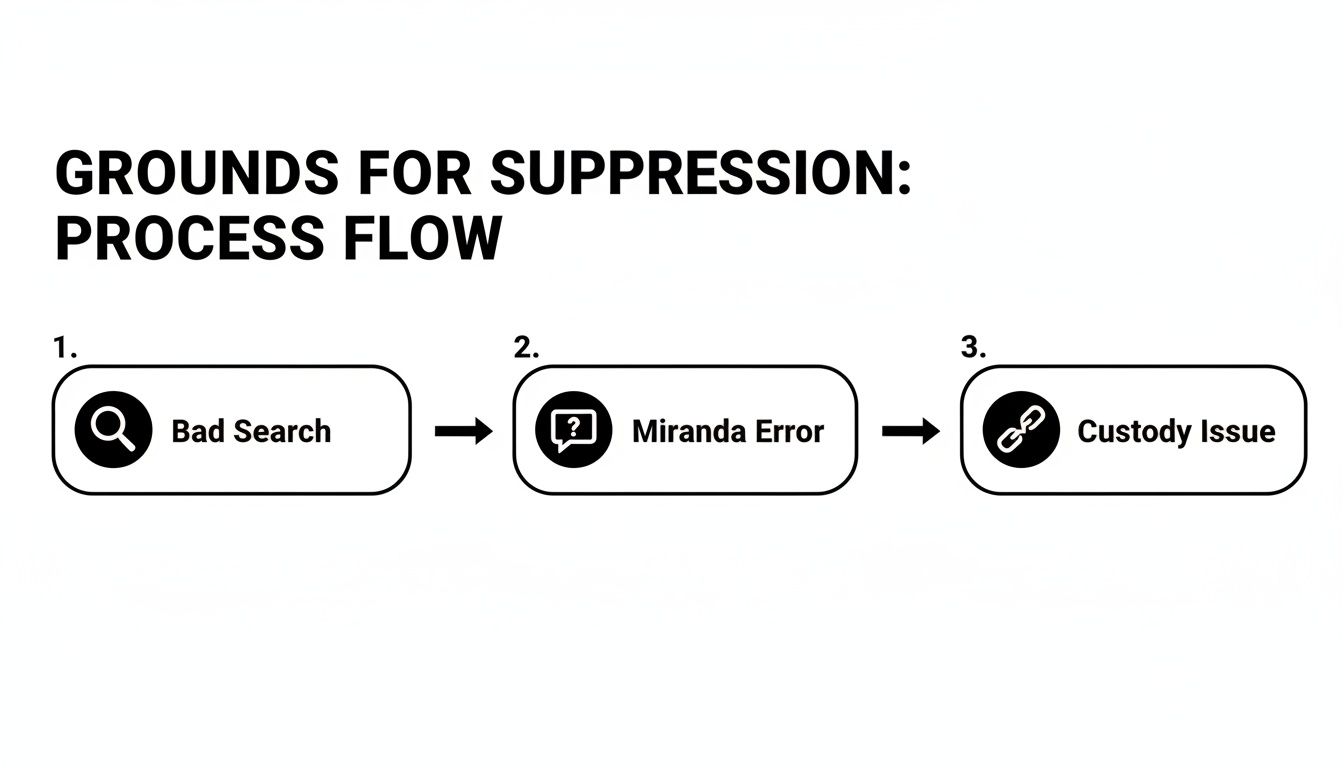
As you can see, the motion is usually triggered by a specific problem—an illegal search, a mistake in handling a confession, or a break in the evidence's chain of custody.
The Initial Filing and the Prosecution's Response
The first real move is for a defense attorney to file a written motion to suppress. This isn’t a simple form; it's a carefully crafted legal argument submitted to the court that has to do a few key things:
- Pinpoint the exact piece of evidence the judge is being asked to throw out.
- Lay out the legal reasons for the request, citing the Constitution and relevant court cases.
- Give a detailed account of how the police got the evidence, pointing out precisely where rights were violated.
Once that motion is filed with the court and served to the prosecutor, the ball is in their court. The State's attorney will comb through the claims and draft their own formal written response. In that document, they'll argue why they believe the evidence was collected by the book and why the judge should let them use it at trial.
This back-and-forth on paper sets the stage for the main event, making sure both sides have their arguments clearly defined before anyone steps into the courtroom to testify.
The Suppression Hearing: A Courtroom Showdown
After the written arguments are filed, the judge sets a date for a suppression hearing. This can be thought of as a mini-trial focused on one single question: did law enforcement follow the law? There’s no jury. The judge is the one who hears the facts and makes the final call.
At the hearing, both sides get to present their case. Here’s how it usually unfolds:
-
Officer Testimony: The prosecutor puts the police officer(s) on the stand. They'll tell their side of the story—why the traffic stop was made, what they claim they saw to justify a search, or the circumstances around a statement that was made.
-
Cross-Examination: This is a key moment for the defense. The defense attorney will cross-examine the officer, challenging their version of events. The goal is to look for holes in their testimony and point out any inconsistencies between what they say in court and what the evidence, like bodycam footage, actually shows.
-
Presentation of Defense Evidence: The defense can also present its own evidence. This might mean calling witnesses to the stand or showing the judge photos or video recordings that tell a different story than the officer's.
-
Legal Arguments: Finally, both attorneys make their closing arguments directly to the judge. Each side will summarize the testimony and explain why the law supports their position—the defense arguing to suppress the evidence and the prosecutor arguing to keep it.
This hearing is often the first—and only—time an officer’s actions are put under a microscope in a courtroom. It's an absolutely vital chance for the defense to test the strength of the State's case and the credibility of its main witnesses.
The judge listens to all the testimony and legal arguments. Sometimes, they'll make a decision right there from the bench. Other times, they’ll take the matter "under advisement" to go back and review everything before issuing a formal written order. That ruling determines whether the challenged evidence is seen by a jury or is gone from the case for good.
The Strategic Impact of a Successful Suppression Motion
Winning a motion to suppress evidence can completely turn a criminal case on its head. It isn't just a minor victory on some legal technicality; it's a game-changing event that can force the prosecution to rethink its entire strategy and, ultimately, protect a defendant's future. When a judge agrees to throw out a key piece of evidence, the impact is felt through every other stage of the case.
Think of the prosecutor's case like a brick wall, with each piece of evidence serving as a brick. A successful suppression motion doesn't just chip away at that wall—it can pull out the cornerstone, making the whole structure shaky or even causing it to collapse.
Weakening the Prosecution's Case
The most immediate result of winning this motion is that the prosecutor's case gets a lot weaker. In many situations, the suppressed evidence is the main thing holding up the state’s entire argument.
Here are a few common scenarios seen in Forsyth or Cobb County:
- DUI Cases: If the breathalyzer or blood test results get tossed because the traffic stop was illegal, the prosecutor loses their scientific proof of intoxication. All they're left with are the officer's subjective observations, which are much easier to challenge in court.
- Drug Possession Charges: When drugs found during a questionable car search in Roswell are excluded, the prosecution might have nothing left to prove possession. Without the physical drugs, the case often just falls apart.
- Theft Cases: If a confession to a theft in Marietta is suppressed because of a Miranda rights violation, the state could lose its most powerful tool for linking the accused to the crime.
When this happens, the prosecutor has to take a hard look at their case. They're forced to ask, "Without this evidence, can guilt still be proven beyond a reasonable doubt?" More often than not, the answer is no.
The loss of key evidence shifts all the leverage in a case. Suddenly, the prosecutor’s "slam-dunk" becomes an uphill battle they may not be willing to fight at trial.
This shift in power is real. Winning a suppression motion can lead directly to dismissals or acquittals because the prosecutor's core evidence vanished. More can be learned about how these motions can turn a losing case into a winner.
Creating Favorable Outcomes
A weakened case forces the prosecutor's hand, often leading to better outcomes that weren't on the table before. Instead of risking a loss at trial, the state often becomes much more open to making a deal.
This can lead to a few positive results:
- Reduced Charges: The prosecutor might offer to reduce a felony to a misdemeanor, which comes with much lighter penalties.
- Favorable Plea Offers: A plea agreement with less (or no) jail time, smaller fines, or just probation might suddenly become available.
- Complete Dismissal: In the best-case scenario, if the suppressed evidence was the only thing connecting a person to the alleged crime, the prosecutor may have no choice but to drop the charges completely.
The Value of a Denied Motion
Even if the motion to suppress is denied, filing it still provides tremendous strategic value. The suppression hearing is essentially a dry run for trial, giving a defense attorney a priceless opportunity to see the state’s case in action.
During the hearing, an attorney gets to cross-examine the police officers under oath. This locks in their testimony, exposes weaknesses, and reveals inconsistencies between what they say and what the evidence, like bodycam footage, actually shows. That kind of information is invaluable for building a strong defense for trial, making the motion a critical tool no matter how the judge rules.
How an Experienced Defense Attorney Can Help
Navigating the legal maze of a motion to suppress evidence is not a DIY project. It is a complex battleground where a deep understanding of constitutional law, case precedent, and court procedure is non-negotiable. This is precisely where a skilled defense attorney becomes a critical asset.

An experienced attorney knows exactly what to look for when they get a case file. They will dig into every piece of paper and every second of video—police reports, body camera footage, search warrants, and witness statements—to find the constitutional violations that others would easily miss.
This isn't just a review; it's the foundation for building a powerful, persuasive argument that can change the entire course of a case.
The Value of Local Knowledge
When facing charges, local experience isn't just a bonus—it's a massive advantage. An attorney who is a familiar face in the courtrooms of Forsyth County and Cobb County brings a unique edge to a defense. For a case in Alpharetta, Cumming, or Marietta, it helps to have someone who knows the local legal landscape inside and out.
This familiarity translates into real benefits:
- Knowledge of Local Procedures: They know the unwritten rules, the specific filing deadlines, and the preferences of the local judges.
- Understanding of Prosecutors: Having gone up against the local prosecutors before, they have a good idea of how they’ll react to a motion and what their tactics will be.
- Credibility in the Courtroom: A respected local attorney's arguments simply carry more weight.
Choosing the right representation is one of the most important decisions to be made. An attorney's ability to spot a Fourth Amendment violation or a procedural error can change the entire outcome of a case.
Ultimately, a defense attorney's job is to be the shield that protects a client's constitutional rights at every turn. They have the training and experience to challenge the government's evidence and hold law enforcement accountable when they overstep. More information on this topic is available in the detailed guide about how to find a good criminal lawyer.
It is always important to understand the legal process. The first step toward building a strong defense is to sit down with a knowledgeable legal professional who can review the facts of the case and explain the options.
Common Questions About Motions to Suppress
When someone is caught up in the criminal justice system, it’s completely normal to have a lot of questions. The idea of a "motion to suppress evidence" can sound particularly confusing, so let’s clear up some of the most common points.
Can a Motion to Suppress Be Filed in Any Criminal Case?
Yes. A motion to suppress is a fundamental tool that can be used in almost any criminal case, from a misdemeanor DUI to a serious felony charge. Its power isn’t tied to how severe the charge is—it’s all about the actions law enforcement took during the investigation.
If there is reason to believe the police obtained evidence by violating someone's constitutional rights, this motion can be filed. This applies just as much to drug possession cases in Cumming as it does to theft charges in Marietta or any other criminal matter across Georgia. The central question is always the same: did law enforcement follow the proper legal procedures?
Does Filing This Motion Make Someone Look Guilty?
Absolutely not. Filing a motion to suppress is a standard, expected part of a strong criminal defense. It is not an admission of guilt.
Think of it this way: it signals that the defense team is doing its job. They are holding the government accountable and making sure constitutional rights are protected. A judge sees this as a legal challenge to the state's procedures, not as a reflection on a defendant's character. The entire focus is on the legality of what the police did.
How Often Do These Motions Actually Work?
It’s important to be realistic here. Winning a motion to suppress outright is tough because the legal bar is high. But success isn't just measured by getting a piece of evidence thrown out.
One multi-city study on search warrant activity found that motions to suppress were granted in less than 1% of the warrants reviewed. That same study noted only about 1.5% of defendants were released immediately after a successful motion, and those were typically for lower-level offenses. The full findings can be reviewed on search warrants and suppression motions for a deeper look.
While those numbers show that a clear "win" is rare, the strategic value of filing the motion is huge. The process itself can expose major weaknesses in the prosecution's case, lock in an officer's testimony under oath, and create powerful leverage for negotiating a better plea deal or even a dismissal. It's a critical defensive tool, regardless of the final ruling.
Understanding what a motion to suppress is represents the first step, but using it effectively requires deep legal knowledge and courtroom experience. For individuals facing charges in Alpharetta, Roswell, Johns Creek, or anywhere in Forsyth and Cobb Counties, a defense built by someone who has been there is essential. At Brian Hansford Law, we meticulously examine every detail of a case to protect our clients' rights. Contact us today to discuss your situation at https://challengemycharge.com.
