
When a case lands on a prosecutor's desk, they hold a surprising amount of power. This power is called prosecutorial discretion, and it’s one of the most critical, yet least understood, aspects of the criminal justice system. In short, prosecutors get to decide whether a case moves forward, what charges to file, or if the whole thing should be dropped. They are the gatekeepers of the entire system.
Understanding The Power Of A Prosecutor

The concept isn't just some legal theory; it's a practical necessity. As the Wikipedia entry explains, the justice system simply doesn't have the resources to prosecute every single alleged crime. This authority allows prosecutors to make judgment calls based on the facts in front of them.
Think of it like a seasoned coach deciding which players to put on the field. The coach looks at the evidence (each player's skill, the opponent's weaknesses) and then makes a strategic decision. A prosecutor does the same thing with a criminal case. They review the police reports, witness statements, and physical evidence to decide if the case is strong enough to "play."
This authority isn't a one-time decision, either. It influences a case from the moment an arrest is made until a final resolution is reached.
Key Decisions in a Prosecutor's Hands
At its heart, prosecutorial discretion allows the District Attorney's office to make a few key moves. These decisions are supposed to be guided by the strength of the evidence, the law, and the practical limits of their resources.
To give you a better idea of what this looks like in practice, here is a quick summary of their main powers.
Key Aspects of Prosecutorial Discretion
| Key Power | What It Means |
|---|---|
| Filing Charges | After an arrest, they decide if there's enough evidence to formally accuse someone of a crime. |
| Choosing Charges | They select the specific crimes to charge, which could be anything from a simple misdemeanor to a serious felony. |
| Offering Plea Bargains | They can offer a deal to plead guilty to a lesser charge in exchange for avoiding a trial. |
| Dismissing a Case | If the evidence is weak or new facts come to light, they can drop all charges at any point. |
Each one of these powers can completely change the trajectory of someone's life.
Here’s a breakdown of the most common ways prosecutors exercise their discretion:
- Deciding to File Charges: The first and most important call. After reviewing an arrest report, the prosecutor decides if there's enough solid evidence to even start a case.
- Choosing Specific Charges: If they move forward, they pick the exact crimes to charge. This is a huge deal—it can be the difference between facing a minor fine and years in prison.
- Offering Plea Bargains: This is where most cases end. A prosecutor can offer a defendant a chance to plead guilty to something less serious to wrap the case up without a trial.
- Dismissing a Case: A prosecutor can decide the case isn't worth pursuing and drop the charges. This can happen anytime, often because the evidence is too weak or a key witness is no longer available.
This power ensures that the justice system can focus its limited resources—like court time and personnel—on the most serious and viable cases, aiming for efficient and fair resolutions.
Understanding Why This Authority Exists
The whole idea of prosecutorial discretion comes down to one simple, practical truth: our justice system can't possibly prosecute every single crime that occurs.
Think of it like an emergency room. If every single patient—from someone with a paper cut to another with a life-threatening injury—got the same level of immediate attention, the entire system would grind to a halt. The most critical cases would get lost in the chaos.
Prosecutors are a bit like the triage nurses in that scenario. Their job is to assess the situation and prioritize cases to make sure the most serious offenses get the focus they demand. This isn't about picking and choosing at random; it's a vital tool for managing limited resources like court time, staff, and taxpayer money. Without it, our court dockets would be hopelessly clogged with minor infractions, delaying justice for everyone.
Balancing Justice With Reality
This power allows the system to balance the black-and-white letter of the law with the real-world spirit of justice. Let's be honest, not every case calls for the full weight of a criminal prosecution. Sometimes, a diversion program or a less severe charge is a much better outcome for both the community and the individual involved.
Prosecutorial discretion is the system’s way of acknowledging that a one-size-fits-all approach to justice is not only impossible, but often unfair. It creates the flexibility needed to find outcomes that are proportional and effective.
A huge part of this authority is deciding what charges to file, if any, and how to move forward. This includes negotiating plea bargains or even dismissing a case entirely. While some countries require every offense to be prosecuted, the U.S. gives prosecutors broad discretion. This approach helps focus resources where they're needed most. One can learn more about how this works globally on Wikipedia.
Of course, these decisions are heavily tied to the available evidence. A prosecutor constantly has to ask, "Do we have enough proof to move forward?" This is a different calculation than the burden of proof required to win a conviction at trial. Ultimately, this authority is a cornerstone of a functioning justice system, designed to use finite resources wisely while aiming for fair results.
How Prosecutors Make These Decisions
When an arrest report first lands on a prosecutor’s desk, the real work begins. Before they ever think about guilt or innocence, they have to decide if the case is even viable. Think of the prosecutor as a triage doctor, quickly assessing the strength of the evidence brought in by law enforcement.
They're asking some hard, practical questions. Do we have credible witnesses? Was the physical evidence collected legally? Does what we have actually add up to the legal definition of a specific crime? This initial review is a critical filter, designed to weed out cases that are dead on arrival from the very start.
This infographic breaks down the decision-making process, showing how things like limited resources and public safety concerns force a prosecutor to prioritize.
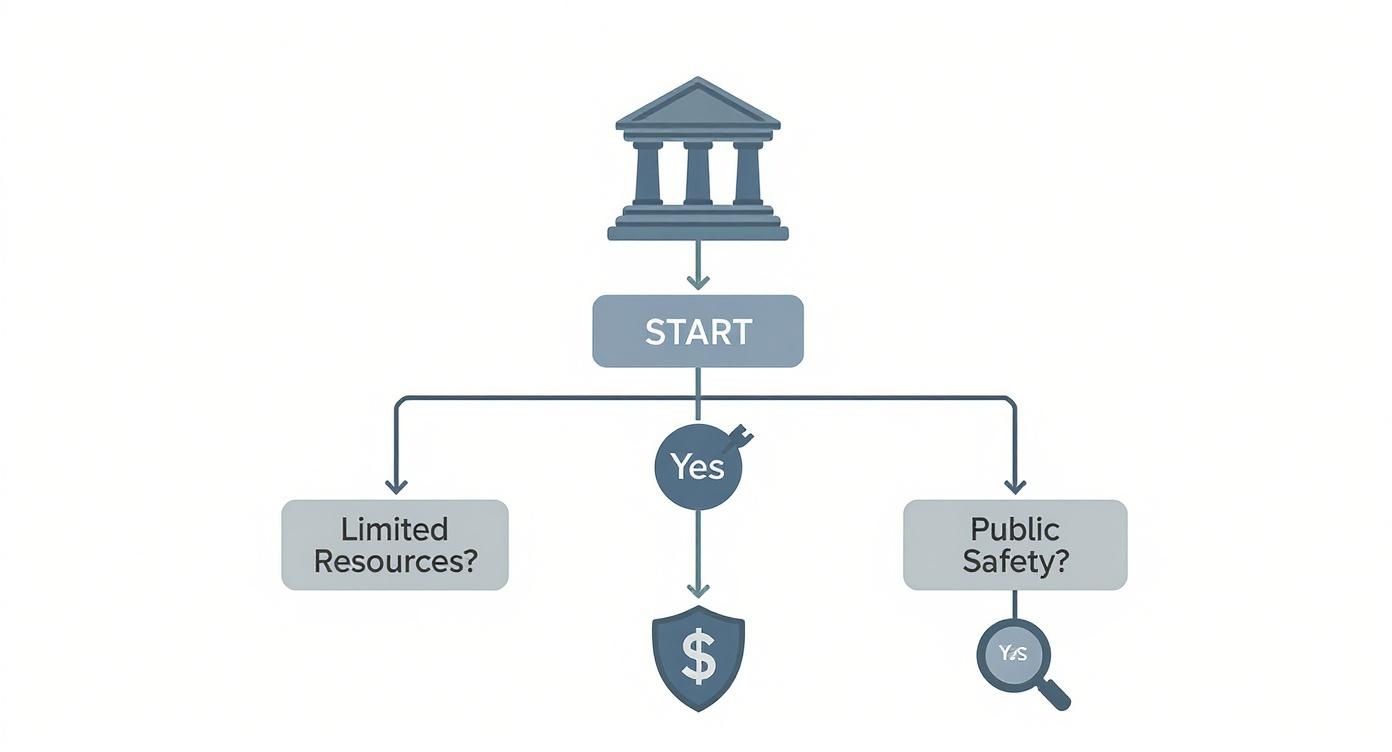
As one can see, a prosecutor’s choices are often a practical response to the real-world pressures of the job, not just a matter of following abstract legal rules.
Weighing the Case and Considering Options
Once a case makes it past that first look, the prosecutor’s real power—their discretion—comes into play. It's not just if they should charge someone, but what they should charge them with. This single decision can drastically alter the entire trajectory of a case and determine the severity of potential penalties.
A prosecutor's choice of charges sets the entire tone for the case, influencing everything from potential plea bargains to the resources the office will dedicate to it.
Throughout this stage, there's often a back-and-forth with the defense attorney. A defense lawyer can point out weaknesses in the state's evidence or present mitigating factors the prosecutor might have overlooked. These conversations can lead to a few different outcomes:
- Proceeding with original charges: This usually happens when the prosecutor feels the evidence is rock-solid and they have a strong chance of winning at trial.
- Offering a plea to lesser charges: If the case has some holes, a plea bargain becomes an attractive and practical option for the state.
- Dismissing the case: Sometimes, new information brought forward by the defense or uncovered during further investigation makes it clear the case just isn't worth pursuing.
Ultimately, this whole process is a living example of what prosecutorial discretion is: a series of critical judgment calls that blend hard legal standards with the practical realities of the justice system.
When a prosecutor is deciding what to do with a criminal case, it's not a random choice. Their decision comes from a careful calculation, weighing several factors much like a pilot runs through a pre-flight checklist. Each piece of information helps guide the final call on how, or even if, a case should move forward.
The first and most important factor is always the strength of the evidence. A prosecutor has to be realistic. Are the available facts—witness statements, physical evidence, and police reports—strong enough to prove guilt beyond a reasonable doubt? If the evidence is shaky, pursuing charges might just be a waste of taxpayer money and court resources.
Another major consideration is just how serious the alleged crime is. Violent crimes that pose a direct threat to communities in places like Alpharetta or Forsyth County are naturally going to get more attention than minor, non-violent offenses.
A Deeper Look at the Decision Matrix
Beyond the crime itself, prosecutors look at the person involved. The defendant’s criminal history plays a huge role. A first-time offender accused of a minor shoplifting charge will likely be treated very differently than someone with a long rap sheet of similar offenses.
The impact on the victim and the community is also a critical piece of the puzzle. Prosecutors will often consider what the victim wants and think about the message a prosecution—or a dismissal—would send to the public about safety and faith in the justice system.
These are the legal, practical, and ethical reasons prosecutorial discretion exists. It's built into the system to allow for nuance, avoiding a rigid, one-size-fits-all approach for every single case. By law, a prosecutor’s duty is to seek justice, not just rack up convictions. There is research explaining how this discretion is supposed to balance individual rights with the public's interest.
This delicate balance also means that challenges, like unconscious biases influencing decisions, must be acknowledged. That's why accountability measures and clear office policies are so essential to ensure fairness across the board.
Ultimately, the goal is to use this powerful authority to find a just and reasonable outcome based on all the facts at hand.
Seeing Prosecutorial Discretion In Action

It’s one thing to talk about prosecutorial discretion in theory, but seeing how it plays out in the real world makes the concept crystal clear. This isn't just some abstract legal idea; it's a powerful tool that shapes case outcomes every single day in courtrooms across Cobb County and beyond.
The same exact charge can lead to completely different futures for two different people, all based on a prosecutor’s judgment call. Let's walk through a few common scenarios to see what this looks like on the ground.
Common Real-World Scenarios
These examples show the wide range of decisions a prosecutor can make, from offering a second chance to pursuing the toughest penalties available.
-
Offering a Plea Bargain: Imagine someone gets arrested for a first-time, non-violent drug offense. Instead of gearing up for a lengthy trial, the prosecutor might offer a deal to plead guilty to a lesser misdemeanor. This move saves court resources and gives the person a path to avoid a felony conviction. Deciding to make that offer is a classic use of discretion.
-
Dismissing a Case: A case might look solid at first glance. But as the prosecutor digs in, they discover key evidence was collected during an improper search. Knowing that evidence will almost certainly be thrown out, they use their discretion to dismiss the charges entirely rather than waste everyone's time on a case they can't win.
-
Diverting to a Program: Think about a young adult in Roswell charged with misdemeanor theft. If it’s their first offense and they seem genuinely remorseful, the prosecutor might steer them toward a pre-trial intervention program. After successfully completing it, the charges get dropped, and they walk away without a criminal record.
These examples really highlight how a prosecutor's decisions can lead to dramatically different outcomes. And since plea deals are so common, understanding the pros and cons of a plea bargain is absolutely essential for anyone caught up in the system.
In the United States, prosecutorial discretion is uniquely powerful. Prosecutors have the sole authority to file or decline charges, negotiate pleas, and seek dismissals.
This monopoly over starting a case gives their decisions an immense impact. Research shows that roughly 90-95% of all convictions come from plea agreements, not trials, which puts the prosecutor right at the center of the justice system.
A Colorado study broke it down even further, finding that 55.8% of cases ended in guilty pleas, 17% were dismissed, and 14% received deferred judgments—all discretionary outcomes. The numbers don't lie; a prosecutor's choice is often the most important factor in a criminal case.
Common Myths And Misconceptions
Thanks to courtroom dramas and TV shows, a lot of people have the wrong idea about prosecutorial discretion. These myths create a skewed picture of a prosecutor’s power and what they can actually do. Let’s clear a few things up and look at the practical realities of the criminal justice system.
One of the biggest misconceptions is that prosecutors have unlimited, unchecked power. That’s just not true. While their discretion is broad, it is certainly not absolute. Prosecutors are bound by legal statutes, ethical codes, court rules, and, of course, the U.S. Constitution. Every decision they make has to be based on evidence and law, not personal feelings.
Another common myth is that a victim's wishes automatically dictate the outcome of a case. While a victim's input is always an important factor, the final call to press or drop charges rests with the prosecutor, who represents the interests of the state.
Setting the Record Straight
Let's tackle a few more common misunderstandings head-on.
- Myth 1: Prosecutors must charge every single crime. They don't. With limited resources and a duty to seek justice, prosecutors have to prioritize serious offenses and cases with strong evidence. That often means declining to pursue weaker or less severe ones.
- Myth 2: Discretion means being "soft on crime." This power is about being smart, not soft. It allows prosecutors to focus their resources on the biggest threats to public safety and find more effective outcomes, like sending a low-level offender to a diversion program instead of jail.
- Myth 3: One cannot challenge a prosecutor's decision. While it’s definitely difficult, it's not impossible. In rare cases where a decision was clearly based on discrimination or serious misconduct, it can lead to an abuse of process claim.
At the end of the day, prosecutorial discretion is a complex balancing act. It isn't about winning every single case, but about making calculated decisions that serve the broader interests of justice within a system of limited resources.
Your Questions About Prosecutorial Discretion, Answered
For those facing criminal charges, understanding the power a prosecutor holds is critical. Here are some common questions about what they can—and can't—do.
What Stops a Prosecutor from Doing Whatever They Want?
While prosecutors have a lot of power, it’s not unlimited. Their decisions are shaped by a few key constraints that ensure the system has checks and balances.
- Legal Statutes: State laws draw a hard line. A prosecutor can't file a charge that doesn't exist or isn't supported by the evidence under Georgia law.
- Ethical Rules: They have a duty to seek justice, not just rack up convictions. This means they must act fairly and ethically throughout the process.
- Resource Constraints: Every DA's office has a budget. They simply don't have the time, money, or staff to take every single case to a jury trial.
- Policy Guidelines: The District Attorney often sets office-wide policies on how to handle certain types of cases or what kind of plea offers are standard.
Think of it this way: a prosecutor can’t just invent a charge out of thin air. They have to follow the rulebook, which includes everything from state law to their own office's internal guidelines. This is why many legal challenges to their decisions focus on procedural mistakes or ethical missteps.
What Role Does a Victim Play in the Prosecutor's Decision?
This is a common point of confusion. Victims have a voice, but they don't have the final say. Their input is important and can influence things like sentencing recommendations or bail conditions, but it's ultimately advisory.
The prosecutor has to weigh the victim's wishes against the evidence, legal standards, and their office policies before deciding how to proceed.
- Impact Statements: Victims are often given the chance to share how the crime has affected them. This can happen during plea negotiations or at sentencing and can be very powerful.
- Consultation Rights: In some places, the law requires the prosecutor to talk with the victim before dismissing a case or offering a plea deal.
- Limited Veto Power: While victims can't single-handedly stop a case from moving forward, in some jurisdictions like Forsyth County and Cobb County, they can request hearings to make their objections known to a judge.
Can a Prosecutor’s Decision Be Challenged?
Challenging a prosecutor's discretion is tough, but not impossible. These decisions are rarely overturned because the courts give them wide latitude. However, there are a few avenues for review.
An appeal might be filed if there's an argument that the prosecutor abused their power by applying it in a discriminatory or completely arbitrary way. Another route is a petition for a writ of mandamus, though these are notoriously difficult to win.
In fact, only about 2% of mandamus petitions succeed because the legal standard is so high.
In counties like Alpharetta, Milton, Roswell, and Johns Creek, here are the main options for seeking a review:
- File a petition for a writ of mandamus, arguing the prosecutor clearly violated their legal duties.
- Raise the issue on appeal after a conviction, focusing on a procedural error or ethical breach.
- Request an internal review from the District Attorney’s office or file a complaint with the state ethics board.
For now, the reality is that prosecutors in areas like East Cobb, Marietta, and Cumming hold significant control over who gets charged and what deals are offered. Getting a decision reversed is an uphill battle, but not one to face alone.
Explore defense strategies with Brian Hansford Law in Alpharetta. If you're dealing with a local criminal case, contact us for immediate help.
