
We like to think of a criminal trial as a fair fight, but what happens when the person meant to enforce the rules—the prosecutor—starts breaking them? That’s the heart of prosecutorial misconduct. It’s any unethical or illegal action a prosecutor takes to win a conviction, trampling a defendant's constitutional rights in the process.
This isn't about a simple mistake or a tough but fair legal strategy. It’s about a prosecutor intentionally or negligently overstepping their bounds, corrupting the very foundation of our justice system.
Defining Prosecutorial Misconduct
Think of it this way: a prosecutor’s job isn’t just to win. They have a sworn duty to act as a "minister of justice," ensuring the game is played by the rules. When they decide winning is more important than fairness, they’ve crossed a dangerous line.
Prosecutorial misconduct is about behavior so improper that it robs the defendant of their fundamental right to a fair trial. It's a betrayal of the immense power and public trust placed in their hands.
The Core Elements of Misconduct
So, what does it take for a prosecutor's action to legally qualify as misconduct? It generally boils down to a combination of three critical factors. Understanding these helps clarify the difference between an aggressive but legal approach and a genuine violation of a person's rights.
Here’s a simple breakdown of the components that typically define an instance of prosecutorial misconduct.
| The Core Elements of Prosecutorial Misconduct |
| :— | :— | :— |
| Element | Simple Explanation | Example |
| The Improper Action | This is the specific thing the prosecutor did that violated a rule or ethical standard. | The prosecutor knowingly hides a key piece of evidence that could prove the defendant's innocence. |
| The Prosecutor’s Intent | This looks at the prosecutor's state of mind. Was the action a deliberate choice to cheat, or was it a result of gross negligence? | The prosecutor deliberately tells a witness to lie on the stand to secure a conviction. |
| The Impact on the Trial | The action must have actually harmed the defendant's case, making the trial unfair. | The prosecutor's inflammatory closing argument so prejudiced the jury that they couldn't deliver an impartial verdict. |
When these three elements align, it's not just a minor error—it's a serious breach of duty that can have devastating consequences for the accused.
The Broader Consequences
This isn't just a theoretical problem; it has real-world consequences that destroy lives. According to the National Registry of Exonerations, prosecutorial misconduct has played a role in a staggering number of wrongful convictions. Since 1989, more than 3,175 people have been exonerated after being found innocent, collectively spending over 27,000 years locked away for crimes they didn’t commit.
It's crucial to distinguish misconduct from the lawful power prosecutors wield every day. The authority to decide who to charge and what crimes to pursue is known as prosecutorial discretion. But when that discretion is abused—driven by a win-at-all-costs mentality—it leads directly to the kind of misconduct that undermines justice for everyone.
Common Examples of Prosecutorial Misconduct
It’s one thing to understand prosecutorial misconduct as a concept, but it's another thing entirely to see how it actually plays out in a real courtroom. Misconduct isn't always some dramatic, movie-style outburst. More often, it shows up in subtle yet incredibly damaging ways that can completely change the outcome of a case.
These actions aren't just overly aggressive tactics; they are direct violations of the established rules and ethical duties that every prosecutor is sworn to uphold. To really get a handle on what prosecutorial misconduct looks like, you have to examine the specific forms it most often takes.
Hiding Evidence That Could Help the Defense
This is one of the most serious and, unfortunately, common forms of misconduct. It involves the failure to turn over exculpatory evidence—that’s any evidence that could help prove a defendant's innocence or even just reduce their sentence. Legally, this is known as a Brady violation, named after a landmark U.S. Supreme Court case.
Imagine a prosecutor is handling an assault case, and the person charged claims it was self-defense. During the investigation, police find a witness who says they saw the alleged victim throw the first punch. That statement is classic exculpatory evidence. The prosecutor has a constitutional duty to give that witness's statement to the defense team, regardless of whether they ever plan to call that witness at trial.
When a prosecutor deliberately hides that kind of information, they're preventing the defendant from mounting a full and fair defense. It stacks the deck for the state and completely undermines the entire point of a trial: to find the truth.
"A prosecutor's duty is not to win a case, but to see that justice is done." This core principle is why they must disclose all relevant evidence. Hiding favorable information is a direct path to an unjust conviction.
The consequences are devastating. Studies of wrongful convictions consistently show that hiding favorable evidence is a leading cause of these miscarriages of justice. In fact, an analysis from the Death Penalty Information Center revealed that in cases involving prosecutorial misconduct, a staggering 35% involved withholding favorable evidence. This really drives home how critical transparency is to a fair trial.
Using Testimony Known to Be False
Another blatant form of misconduct is when a prosecutor knowingly uses false testimony to get a conviction. This can happen in a couple of ways:
- Putting a witness on the stand who they know is lying.
- Failing to correct testimony they know is false. If a witness says something untrue on the stand, the prosecutor has a duty to correct it, not just let the jury believe a lie.
A classic example is when a prosecutor offers a jailhouse informant a sweetheart deal for a reduced sentence in exchange for testifying against a fellow inmate. If the prosecutor knows that informant is just making up a story to get the deal, putting them on the stand to repeat those lies is a severe ethical and legal breach.
This tactic preys on the jury's natural trust in the evidence presented by the state. When a prosecutor knowingly presents lies as facts, they aren't just misleading the jury—they are actively manufacturing a wrongful conviction.
Making Improper and Prejudicial Arguments
A trial is supposed to be a structured, rule-based process. Both sides have to build their arguments based on the evidence presented in court, and nothing more. Misconduct happens when a prosecutor makes improper arguments—especially during opening statements or closing arguments—that are designed to inflame the jury's emotions or prejudices instead of appealing to logic and reason.
Here are a few common examples of improper arguments:
- Appealing to racial or religious prejudice: Making statements that subtly (or not so subtly) encourage the jury to convict someone based on their background.
- Expressing a personal belief in the defendant’s guilt: A prosecutor can't say things like, "I know he did it." Their job is to argue the evidence, not state their personal opinion.
- Commenting on the defendant’s silence: Every defendant has a constitutional right to remain silent. A prosecutor is forbidden from suggesting to the jury that this silence is some kind of proof of guilt.
- Referring to evidence the judge has already excluded: If a judge has ruled certain information inadmissible, the prosecutor can't then try to sneak it in front of the jury.
These types of arguments are calculated to provoke an emotional response, steering the jury away from a logical analysis of the facts. A proper closing argument summarizes the evidence, but an improper one manipulates emotions to win at all costs. Understanding the fine points of these courtroom procedures, including what happens during jury selection, is crucial for spotting when a prosecutor crosses the line.
Tampering With Witnesses or Evidence
This is one of the most corrupt forms of misconduct, involving a direct and often criminal attempt to manipulate the outcome of a trial by interfering with evidence or witnesses.
Examples of tampering include:
- Intimidating a defense witness: Threatening or harassing someone to scare them away from testifying for the defendant.
- Encouraging a witness to lie: Coaching a witness on what to say or pushing them to change their story to better fit the prosecution's narrative.
- Falsifying or planting evidence: This is straight out of a crime drama, but it happens. It can involve creating fake documents, altering physical evidence, or planting something incriminating to frame the defendant.
Think about a situation where a defendant has a key alibi witness ready to testify. If the prosecutor contacts that witness and threatens them with unrelated legal trouble if they take the stand, that's textbook witness tampering. Actions like these make a fair trial impossible because they stop the jury from hearing all the truthful information they need to make the right decision.
What Happens When Misconduct Is Found
Finding out the prosecutor in a case has acted unethically feels like a fundamental betrayal. It can make the entire process feel rigged and hopeless. But it's critical to understand that this isn't the end of the road. In fact, it opens up very specific legal pathways designed to fight back against the injustice. The system has remedies built in to address these kinds of violations.
When misconduct is uncovered, a defense attorney doesn't just stand up and object. Instead, they file formal legal arguments called motions. These are targeted, written requests asking the court to take specific action to fix the prosecutor’s wrongdoing.
Seeking Remedies During Trial
If misconduct is identified before or during a trial, immediate action can be taken. The goal is to stop the damage before it has a chance to unfairly influence the judge or jury. There are a few powerful tools available at this stage.
A primary one is a Motion to Suppress Evidence. This is especially important when the prosecutor's bad behavior leads to the discovery of evidence that shouldn't be part of the case. A strong motion can stop the jury from ever seeing or hearing that tainted evidence, a concept explored more in guides to the exclusionary rule.
Other critical motions include:
- Motion for a Mistrial: If the misconduct is so severe that a fair trial becomes impossible, a lawyer can ask the judge to declare a mistrial. This effectively hits the reset button on the entire proceeding.
- Motion to Dismiss: In the most extreme cases—when the misconduct is intentional and egregious—a motion can be filed to have the charges thrown out completely. This is a high bar, but it is the right remedy for the most severe violations.
These steps are designed to correct the course of a trial in real time, protecting a defendant's rights before a verdict is ever reached.
Challenging a Conviction After the Fact
Sometimes, the evidence of a prosecutor's misconduct doesn't surface until after a conviction. This is unfortunately common with violations like hiding favorable evidence. But even after a guilty verdict, the fight for justice can be far from over.
The fight for fairness does not end when the gavel falls. An appeal or a post-conviction motion based on newly discovered misconduct can be the key to overturning a wrongful conviction.
An appeal is the most direct path. An argument can be made to a higher court that the misconduct at trial was a "harmful error" that directly led to an unfair outcome. If the appellate court agrees, it can reverse the conviction and, in many situations, order a brand new trial.
Another avenue is filing for post-conviction relief. This can happen years later when new proof of the original misconduct—like a hidden witness statement—is finally found. These proceedings give a defendant a chance to present this new evidence and argue that their conviction was fundamentally unjust and should be vacated.
The consequences of these violations are devastating. Research from The Innocence Project drives this point home, finding that in nearly 50% of 65 DNA exoneration cases where misconduct was alleged, courts confirmed there was prosecutorial misconduct or error. This research clearly links government misconduct to wrongful convictions.
This chart shows how some of the most damaging forms of misconduct can play out.
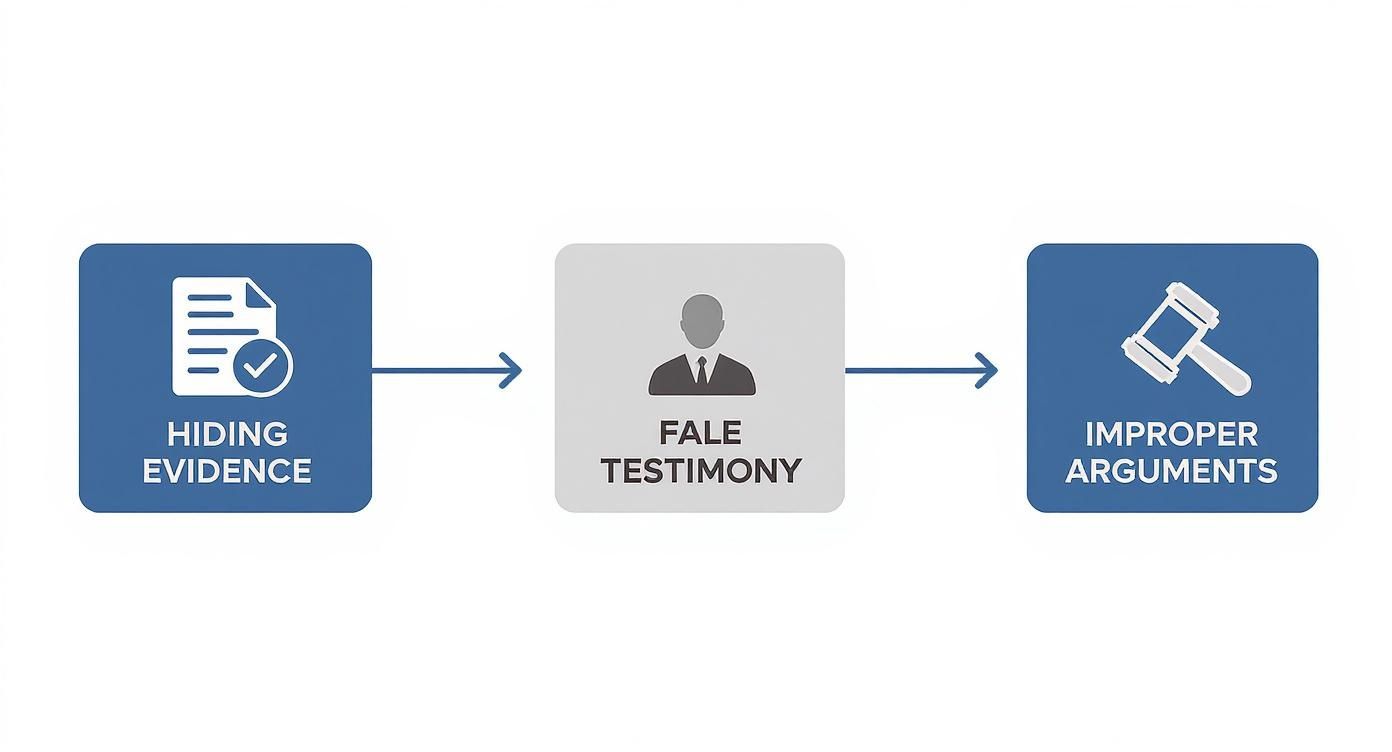
From burying crucial documents to knowingly using false testimony, each action is a deliberate attack on the right to a fair trial.
Potential Remedies for Prosecutorial Misconduct
When misconduct rears its ugly head, the law provides a set of tools to fight back. The specific tool used depends on when the misconduct is discovered—whether it's before, during, or even long after a trial has concluded. The table below breaks down the key procedural options.
| Remedy | When It's Used | What It Aims to Achieve |
|---|---|---|
| Motion to Suppress Evidence | Before or during trial | To exclude illegally or unethically obtained evidence from being presented to the jury. |
| Motion for a Mistrial | During trial | To stop a trial that has been irreparably tainted by severe misconduct. |
| Motion to Dismiss | Before or during trial | To have the charges dropped entirely due to egregious misconduct that violates due process. |
| Direct Appeal | After conviction | To argue that misconduct at trial constituted a "harmful error" requiring reversal of the conviction. |
| Post-Conviction Relief | After an appeal has been lost or time has passed | To introduce newly discovered evidence of misconduct to prove the conviction was fundamentally unfair. |
Each of these remedies serves a distinct purpose, from preventing tainted evidence from ever reaching the jury to overturning a wrongful conviction years down the road. Knowing which path to take is a crucial part of a strong defense strategy.
The Local Impact: How Prosecutorial Misconduct Plays Out in North Georgia
While the rules of a fair trial are written in state and federal law books, the game is played right here in local courts. The real-world application of these standards happens every single day in the district attorney's offices serving Forsyth County and Cobb County.
This isn't some abstract legal theory. For residents in Alpharetta, Cumming, Johns Creek, and Milton, understanding rights is critical. The local prosecutors and courthouses in places like Roswell and Marietta are the front lines where these constitutional protections are either honored or ignored.
Local Decisions, Statewide Rules
Every prosecutor in Georgia is bound by the same Georgia Rules of Professional Conduct. But the day-to-day choices—what evidence to chase down, which charges to file, and how to argue a case to a jury—are made by local DAs. This is why the integrity and training within a specific judicial circuit are so incredibly important.
The District Attorney's office in Cobb County operates separately from the one in Forsyth County, each with its own culture and internal policies. A defendant’s constitutional rights, however, don't change at the county line.
No matter where you are—from a neighborhood in East Cobb to downtown Roswell—the right to a fair trial is non-negotiable. Local court procedures must always bend to these fundamental protections, not the other way around.
Think about it this way: the duty to hand over favorable evidence (a Brady obligation) applies just as forcefully in a Cumming courthouse as it does in Atlanta. It's the local prosecutor's job to make sure their team follows that rule without fail. When they don't, it’s a member of the community who pays the price.
Your Rights Don't Change with Your Zip Code
It's a common myth that justice somehow looks different in a smaller suburban city than in a major metro area. While courtroom practices can vary, core constitutional rights are set in stone.
Whether a person is facing charges in:
- Alpharetta or Milton: They have an absolute right to see all the exculpatory evidence the prosecution has.
- Johns Creek or Roswell: The prosecutor is forbidden from knowingly using false testimony to secure a conviction.
- Marietta or anywhere in Cobb County: A defendant must be protected from inflammatory arguments meant only to poison the jury against them.
A prosecutor holds immense power, but that power has limits. It is checked by a system of rules designed to keep the playing field level. The most important thing to remember is that these protections are a person's rights, regardless of which local courthouse they walk into. The question of what constitutes prosecutorial misconduct is just as relevant on a quiet street in East Cobb as it is anywhere else.
How a Defense Attorney Challenges Misconduct
When a person is facing the full power of the state, the idea of challenging something like prosecutorial misconduct can feel overwhelming, maybe even impossible. It’s not. A sharp criminal defense attorney is an essential check on a prosecutor’s power, using a methodical and strategic game plan to protect constitutional rights.
It all starts with a deep, independent investigation. A good defense team never just takes the prosecution's version of events at face value. Instead, they get to work re-interviewing witnesses, analyzing the physical evidence themselves, and hunting for the inconsistencies and gaps in the state’s narrative.
This hands-on work is absolutely critical because misconduct often hides in the details—a witness statement that was never turned over, or a piece of lab work that directly contradicts the official story.
Scrutinizing Every Piece of Evidence
One of the most important jobs for a defense attorney is to meticulously review every single document, report, and piece of evidence the prosecution provides. This is the discovery process, and the goal is to find what’s missing just as much as what’s there.
For example, if a police report mentions three witnesses at the scene but the prosecution only gives us statements from two, that’s an immediate red flag. Why is the third witness statement missing? Could it contain information that helps the defense?
An experienced defense attorney operates with a healthy dose of skepticism. They know that a prosecutor’s case file may not tell the whole story, and the key to uncovering misconduct often lies in demanding the evidence that wasn't voluntarily provided.
When misconduct needs to be challenged, precise documentation of court proceedings, depositions, and interviews is everything. Using reliable tools for this, like specialized legal transcription software solutions, ensures every word is captured accurately, which makes it much easier to pinpoint contradictions or prove what was said on the record.
Taking Action Through Legal Motions
Once potential misconduct has been identified, the next step is to challenge it formally in court. This isn’t about shouting objections during a trial; it’s done by filing specific legal motions. These are carefully crafted legal arguments demanding that the judge take action.
Depending on the exact situation, a defense attorney might file:
- A Motion to Compel to force the prosecutor to finally turn over that withheld evidence.
- A Motion to Suppress to block illegally obtained evidence from ever being used against a defendant at trial.
- A Motion to Dismiss if the misconduct is so egregious that it has completely destroyed any chance of a fair trial.
Taking these actions requires a deep understanding of legal procedure and the courage to hold the prosecution accountable. Professional experience is non-negotiable for building a strong defense, navigating these complex challenges, and making sure rights are protected every step of the way.
Your Questions About Prosecutorial Misconduct, Answered
When caught in the gears of the justice system, it's natural to have questions, especially if something feels wrong. Let’s tackle some of the most common concerns people have when they suspect a prosecutor has crossed the line.
Can a Conviction Be Overturned Years Later?
Yes, absolutely. If new evidence proving prosecutorial misconduct comes to light long after the fact, it can be the key to unlocking post-conviction relief. Imagine a hidden witness statement or a buried lab report suddenly surfacing—that’s exactly the kind of thing that can be brought back to the court.
Our legal system has pathways to address these injustices because a conviction won by violating someone's rights isn't a true conviction at all. While the legal bar to prove such a claim is high, a wrongful conviction can definitely be challenged and thrown out, even a decade or more after the trial is over.
Distinguishing Honest Mistakes From Misconduct
This is a really important distinction to understand. An honest mistake is just that—a simple error made in good faith. Think of a prosecutor accidentally mixing up a date during their closing argument without any intent to mislead the jury. It's a mistake, but it doesn't automatically poison the whole trial.
Misconduct, however, is a different animal entirely. It involves actions that are negligent, reckless, or flat-out intentional. It’s the difference between accidentally dropping a file and deliberately shredding it. Misconduct happens when the prosecutor’s action—or their failure to act—fundamentally prejudices a defendant's right to a fair trial, whether they did it on purpose or simply didn't care about their duties.
How Difficult Is It to Prove Misconduct?
There's no sugarcoating it: proving prosecutorial misconduct is tough. Courts tend to give prosecutors a lot of latitude, and the burden is squarely on the defense to prove that the prosecutor’s actions weren't just a simple error, but a violation so serious it tipped the scales of justice.
Success here requires a ton of legwork and compelling proof. A defense team has to be relentless—digging through the state’s case, finding every inconsistency, and then building a powerful legal argument for the judge. It takes an incredible amount of skill and persistence to hold the prosecution accountable.
The standard is high because the accusation is serious, but it is not impossible to meet. A well-documented and strategically presented claim can successfully expose misconduct and protect a defendant's fundamental rights.
Ultimately, winning this fight comes down to building an ironclad, evidence-based case that leaves no doubt about how the misconduct impacted the outcome.
If you believe a prosecutor’s unfair actions have compromised your case, you need an advocate who knows how to fight back and win. At Brian Hansford Law, we leverage decades of experience—including my own time as a prosecutor—to fiercely defend your rights. Reach out for a consultation to discuss your situation by visiting our official website.
