
After a DUI arrest, the first moves are often the most important. The process typically involves documenting details of the event, figuring out how to get released, and dealing with administrative deadlines that could impact a driver's license. The timeline can be very tight—often with just 10 days to request a hearing and challenge an automatic license suspension.
Your First 24 Hours After A DUI Arrest
The hours right after a DUI arrest can be a blur of stress and confusion, but what happens in that time can be very important. Actions taken can set the stage for the entire case. The focus is often on three things: gathering information, securing a release, and protecting a license to drive.
The work can begin the moment a person gets out of jail. While the experience is still fresh, it's a good time to write down everything that can be remembered. It's not just about the traffic stop itself—it's about reconstructing the entire chain of events from beginning to end.
Document Every Detail You Can Recall
Memory will never be clearer than it is in the hours right after the incident. It can be helpful to create a detailed, written account of everything that happened. No detail is too small.
Here’s what such an account might include:
- The Traffic Stop: The time, location, and the reason the officer gave for pulling the car over. What were the road conditions like? Was it raining? Dark?
- Conversations: What was said by both parties? It can be useful to recall the exact questions and answers as best as possible.
- Field Sobriety Tests: If any of these were performed, they can be described in detail. Was the ground uneven? Were any injuries or health problems that could have affected balance mentioned to the officer?
- The Arrest and Booking: Note the timeline of the arrest, the method of transport, and what happened at the station. Who was there? What was said during the booking process?
This personal record can be invaluable. It provides a clear snapshot of the circumstances that may be used for reference later, long after the specific details would have otherwise faded.
Navigating Release And Administrative Deadlines
Once booked, the next hurdle is getting released, which usually involves posting bail or bond. Upon release, a stack of paperwork is usually provided. It's important to pay close attention to it. This paperwork includes the citation and, most importantly, a notice about the driver's license.
This is where things can get really time-sensitive. The infographic below breaks down the most critical tasks that often need to be handled right away.
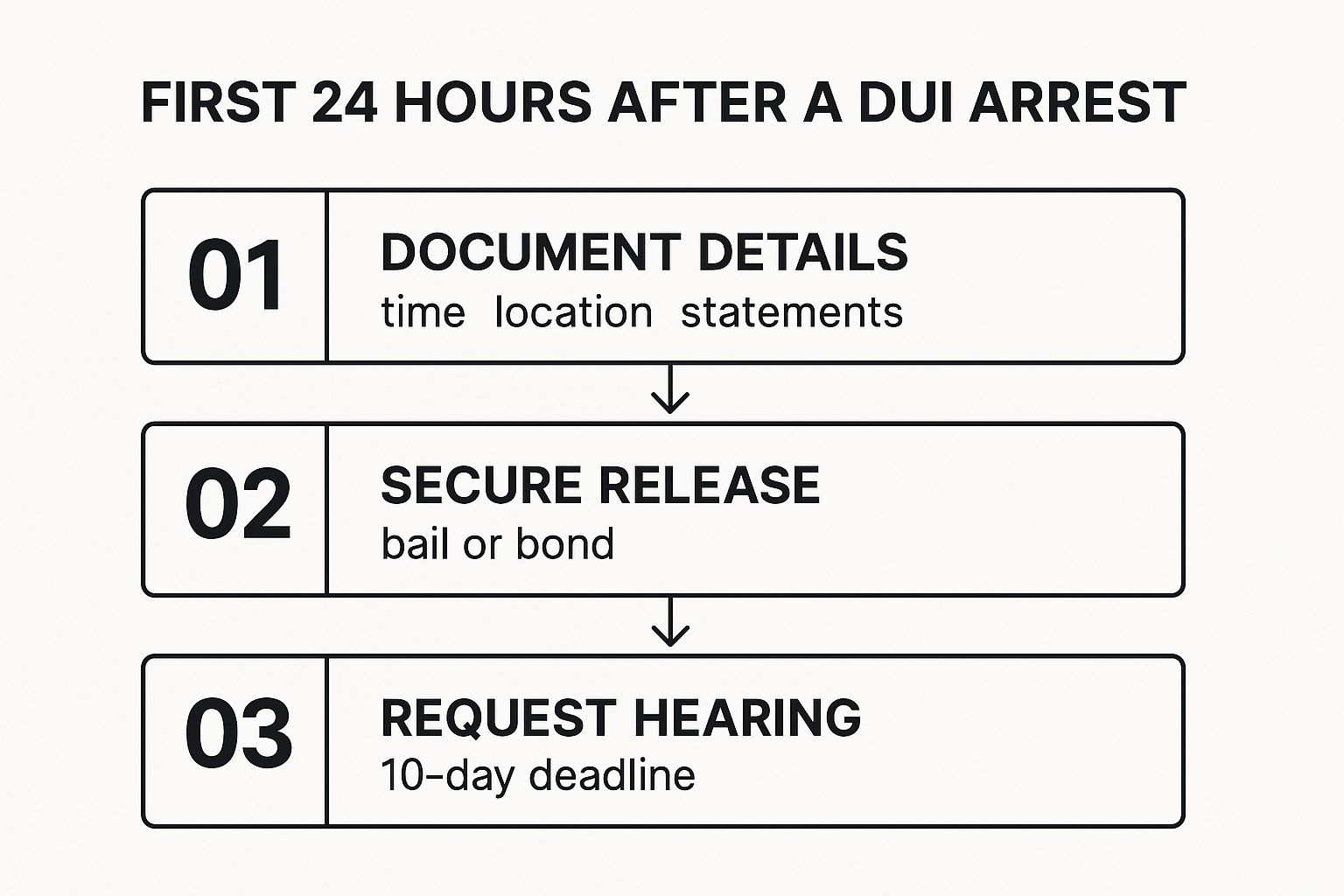
As you can see, documenting the facts, getting released, and requesting that license hearing are the three pillars of the first 24 hours. If the deadline to request an administrative hearing is missed—which can be just a handful of days—the license could be suspended automatically. This suspension is completely separate from whatever happens in criminal court.
The clock starts ticking the second of the arrest. To help stay on track during this critical window, here is a quick checklist of immediate priorities.
Immediate Action Checklist After a DUI Arrest
| Action Item | Why It's Important | Typical Deadline |
|---|---|---|
| Write Down Everything | Memory fades quickly. A detailed account preserves critical facts for later reference. | Within 24 hours |
| Secure Your Release | Getting out of jail allows a person to start working on the case and meet deadlines. | ASAP |
| Request DMV Hearing | This is the opportunity to fight the automatic administrative license suspension. | Often just 10 days |
| Consult a DUI Attorney | An experienced attorney can provide information on the process and how to protect rights. | Within 24-72 hours |
| Keep All Paperwork | The citation, bond papers, and license notices contain crucial information and deadlines. | Ongoing |
Tackling these items immediately can make a significant difference in the outcome of both the administrative license case and the criminal charges. Delays should be avoided.
Navigating the Administrative License Suspension Process
After a DUI arrest, a person's mind is probably racing about the criminal charges and the upcoming court date. But there’s another, more immediate threat to a license that most people overlook: the administrative license suspension. This isn't part of the criminal case. It's a completely separate action handled by the state's Department of Motor Vehicles (DMV), and it moves lightning-fast.
This administrative process is considered a civil matter, not a criminal one. Its stated goal is to get potentially impaired drivers off the road quickly. Because of that, the standard of proof is much lower than what's required in a criminal court, making it an uphill battle for those who try to handle it alone.

The Critical Deadline for Your Hearing Request
When the officer makes an arrest, they usually hand out a stack of paperwork. Buried in there is a notice of suspension, and that piece of paper starts a very important clock. There is an extremely short window—often just 10 to 30 days, depending on the state—to formally request a hearing to fight it.
Missing this deadline is one of the biggest and most costly mistakes that can be made. If the request is not filed in time, the license will be suspended automatically, no matter what happens later in the criminal case.
Think about it this way: someone gets arrested for DUI in Alpharetta, Georgia, and is given a notice that says they have 30 days to appeal the suspension. Their first court date isn't for six weeks. If they wait for that court date to figure things out, they've already missed the boat. The deadline to challenge the administrative suspension will have passed, and their license will be gone.
What Is the Administrative Hearing For?
The administrative hearing is the one shot to challenge the suspension of driving privileges before it goes into effect. It's not a dramatic courtroom trial. It’s a much more low-key proceeding, sometimes held in a small office or even over the phone, where a hearing officer looks at a few specific details of the arrest.
The hearing is usually limited to a handful of key questions:
- Did the officer have reasonable grounds to believe the person was driving under the influence?
- Was the arrest lawful?
- Was the person properly read the implied consent notice (the warning about refusing a chemical test)?
- Did the person either refuse the chemical test or register a blood alcohol concentration (BAC) over the legal limit?
The issue of the chemical test is a big one. Refusing the test can trigger even tougher administrative penalties. To get a better handle on this, you can read more about Georgia's implied consent law and what happens if you refuse a chemical test. This background really shows why the administrative hearing focuses so heavily on this part of the stop.
Potential Outcomes of the Hearing
After reviewing the evidence, the hearing officer will make a decision. There are really only three ways it can go.
Possible Hearing Results:
| Outcome | Description | What It Means for You |
|---|---|---|
| Suspension Set Aside | The officer decides the suspension wasn't justified. | This is the best-case scenario. The administrative action is dismissed, and driving privileges are fully restored while the criminal case proceeds. |
| Suspension Upheld | The officer finds that all legal requirements for the suspension were met. | The license will be suspended for a set period. There might still be options for a restricted or hardship license to get to work or school. |
| Suspension Modified | The officer upholds the suspension but changes the terms. | This could mean a requirement to install an Ignition Interlock Device (IID) to keep driving, or a limited driving permit might be granted. |
Requesting this hearing immediately is one of the most important things that can be done after a DUI arrest. It's the only way to fight the automatic suspension and protect the ability to drive.
Understanding the Charges and Potential Outcomes
A DUI arrest is a whole different ballgame than a simple traffic ticket. It's a serious criminal charge, and the fallout can vary dramatically depending on where the arrest occurred and the specific details of the case.
The first thing to understand is the difference between a misdemeanor and a felony DUI. For most first-time offenders without any major issues, the charge will likely be a misdemeanor. But certain circumstances can instantly bump it up to a felony, and that’s when the consequences get much, much heavier.

Factors That Increase Penalties
Not every DUI is treated the same in the eyes of the law. There are specific elements, known as aggravating factors, that can turn a standard DUI into a much bigger problem. If any of these were part of an arrest, the prosecution may push for tougher penalties.
Here are the most common aggravating factors:
- A High Blood Alcohol Concentration (BAC): If the BAC was well over the 0.08% legal limit, the penalties automatically get worse.
- An Accident Resulting in Injury or Damage: Causing a wreck that damages property or, even more seriously, hurts someone will lead to much graver charges.
- Having a Minor in the Vehicle: Driving under the influence with a child in the car is a massive red flag for any prosecutor or judge and always results in enhanced charges.
- Prior DUI Convictions: A history of DUIs creates a pattern, and the penalties become progressively more severe with each new offense.
These factors are absolutely critical because they define the battleground for the case. Understanding them is the first step when exploring how to beat DUI charges.
The Spectrum of Possible Outcomes
The consequences for a DUI are all over the map. One state might have a certain approach, while another might have a completely different one. Just look at the arrest statistics—Wyoming has an arrest rate of 550 per 100,000 people, but Illinois has a rate of only 18.4 per 100,000. It just goes to show how much location matters.
A conviction isn’t just about potential jail time. It hits a person's wallet, freedom to drive, and even day-to-day life with court-ordered programs.
The penalties are usually a mix-and-match of several different things, including:
- Significant Fines and Fees: These can easily spiral into thousands of dollars once all the court costs and administrative penalties are added up.
- Driver's License Suspension: A license could be lost for anywhere from a few months to several years, depending on the case specifics and driving record.
- Mandatory Education Programs: Courts almost always order offenders into alcohol and drug education classes or treatment programs.
- Ignition Interlock Device (IID): Many states now require the installation of a device in the car that acts as a breathalyzer. If it detects alcohol, the car won't start.
Getting a clear picture of what is at stake is the first step. It helps in understanding just how serious this is and why taking immediate action is so important.
Finding and Working with Professional Representation
Trying to navigate a DUI case by oneself can be an incredibly tough road. The court procedures are confusing, the deadlines are non-negotiable, and the consequences are serious. This is exactly why most people decide to get professional representation to guide them through it.
The right lawyer can make all the difference, but finding that person means doing some homework. It's useful to find someone with specific experience handling DUI cases not just in the state, but in the local courts—like those in Alpharetta or Forsyth County. Local knowledge is a huge asset because every courthouse and prosecutor's office has its own unwritten rules and ways of doing things.

Preparing for Your Initial Consultations
Most defense attorneys offer a free initial consultation. This is a chance to interview them and see if they're the right fit for the case. To get the most out of this meeting, it helps to show up prepared. Gather every single piece of paper related to the arrest and bring it along.
Here’s a quick checklist of what to have ready:
- The Citation or Ticket: This is the official document listing the charges.
- Bail or Bond Paperwork: These papers have all the details of the release from jail.
- Notice of License Suspension: This is the critical form that outlines the administrative action against the license and, more importantly, the 30-day deadline to appeal.
- The Written Account: Bring the detailed notes taken about the arrest as soon as possible.
Walking in organized shows the attorney the situation is being taken seriously and helps them get a clear, immediate picture. It allows them to give a much more accurate assessment of the case.
Questions to Ask a Potential Attorney
Remember, this consultation is a two-way street. While the attorney is evaluating the case, the individual should be evaluating them. The goal is to find a partner—someone experienced, communicative, and trustworthy.
Don't be afraid to ask direct questions about their experience and approach. You are hiring someone for a critical job, and you have a right to feel confident in your choice.
Here are a few questions that can be asked during the meeting:
- How much of your practice is dedicated specifically to DUI defense?
- Have you handled cases in the exact court where mine will be heard?
- What's your strategy for handling the administrative license hearing?
- Who will be my main point of contact at your firm? Will I be speaking with you or a paralegal?
- What is your fee structure, and what exactly does it include?
Finding the right person is one of the most important steps to take after a DUI arrest. For a deeper dive, our guide on how to find a good criminal lawyer offers more tips to help make an informed decision. A good attorney does far more than just show up to court; they handle critical filings, negotiate with the prosecution, and fight for their client at every hearing. Taking the time to choose wisely is the first step toward taking back control.
Preparing for Court Appearances and Long-Term Impacts
The journey through the court system after a DUI arrest can feel overwhelming and, frankly, a bit scary. It all starts with the first court appearance, usually called an arraignment, which is where a plea is entered. This hearing is just the first step in a series of pre-trial procedures, but knowing the general flow can make the whole process feel less intimidating.
Beyond just showing up, how a person carries themselves in court really does matter. It is a good idea to think about the practical details: dress professionally, be on time, and act respectfully toward everyone. These small things add up and contribute to the overall impression made.
What to Expect in Court
The arraignment officially kicks off the criminal case. During this hearing, the judge will read the charges and ask for a plea—typically "guilty," "not guilty," or "no contest." It's very common to plead "not guilty" at this stage. This isn't about denying everything; it simply gives an attorney the time needed to dig into the evidence and explore every possible defense.
After that first hearing, the case shifts into the pre-trial phase. This is where a lot of the real work happens, and it can involve a few key steps:
- Discovery: This is when the prosecution is required to share all the evidence they have. We're talking police reports, breath or blood test results, and any dashcam or bodycam footage.
- Pre-Trial Motions: An attorney can file formal requests with the court to challenge specific issues. For example, they might file a motion to suppress evidence if they believe it was obtained illegally.
- Negotiations: The vast majority of DUI cases never actually go to trial. Instead, they’re resolved through negotiations between the defense attorney and the prosecutor.
The consequences of a DUI are serious—a fact driven home by national statistics. In 2022, drunk drivers were involved in about 32% of all traffic crash fatalities in the United States. The steps taken right after an arrest can have a huge impact on a case. Interestingly, only about 1 in 10 DUI cases go to a full trial, as most are resolved through plea bargains or diversion programs. You can find more insights on these drunk driving statistics on Insurify.com.
Proactive Steps and Long-Term Considerations
While the court process is moving forward, some people decide to get proactive. Voluntarily enrolling in an alcohol education or treatment program before a judge orders it can show the court that the situation is being taken seriously. It’s a powerful way to demonstrate a commitment to addressing the issue head-on.
It's also crucial to look past the courtroom and think about the long-term effects of a DUI. A conviction isn’t just a one-and-done event; it can create ripples that affect a person's life for years to come.
A DUI isn't just a one-time event; it's a long-term mark on a record that impacts finances, career, and daily life. Understanding these future consequences is key to preparing for what lies ahead.
One of the most immediate hits is on car insurance. A DUI conviction automatically puts a person in a high-risk category, and premiums will likely go up—a lot. This higher rate can stick around for several years, creating a significant financial strain long after the court case is closed.
A DUI on a record can also throw a wrench into professional life. Some employers, especially for jobs that involve driving or operating machinery, might see a DUI as a deal-breaker. It can also jeopardize professional licenses in fields like nursing, aviation, or commercial driving. Being aware of these potential roadblocks helps in planning for what's next in a career.
Once the shock of a DUI arrest begins to fade, a wave of questions usually hits. It’s a confusing and isolating experience, but many people wonder what comes next. Most people face the same set of urgent concerns as they try to get their bearings.
A big one is usually about work. People often ask, "Do I have to tell my boss about this?" The answer really depends on the specific situation—the job, the company's rules, and any employment contract that was signed. If a role involves driving or requires a professional license, disclosure will almost certainly be necessary.
Will My Car Be Impounded?
Yes, it’s extremely common for a car to be impounded right after a DUI arrest. Getting it back becomes an immediate problem. The process usually means paying towing and storage fees, which add up every single day the car sits in the lot.
To retrieve the vehicle, a person will need to show up with proof of ownership, valid insurance, and a valid driver's license. If the license was suspended, a licensed driver will need to come along. The key is to act fast, because those storage fees can get out of hand quickly.
Can I Travel Out of State?
This is another question that comes up all the time. Whether a person can travel while their case is pending hinges on the conditions of release. If released on one's own recognizance (an "OR" bond), there might not be any travel restrictions.
However, if a bond had to be posted, the rules are likely much stricter. The terms of release could very well prohibit leaving the state without getting the court's permission first.
It's always critical to read the release paperwork carefully. Violating any condition, including a travel restriction, is a serious mistake. It can get a bond revoked and result in being sent back to jail until the case is over.
Impaired driving is a global issue, but how it's handled varies widely. In the United States, we see an estimated 28 deaths every day from crashes involving alcohol. Other countries, like Sweden, put a heavy emphasis on mandatory rehabilitation programs to stop repeat offenses. These different approaches highlight a universal truth: no matter where you are, getting the right information after a DUI arrest is critical. You can learn more about these global drink driving statistics on jmw.co.uk.
Every question a person has right now is valid and important. Getting clear answers is the first step toward taking control of the situation and preparing for what lies ahead.
Navigating the system after an arrest in Alpharetta, Forsyth County, or the surrounding areas is tough. If you are looking for straightforward information and guidance, the team at Brian Hansford Law can help. With over 25 years of experience, including time as a former prosecutor, we know how to explain your situation and explore your best options. For a detailed consultation, visit us at https://challengemycharge.com.
