
The moments immediately following a DUI arrest are a blur of confusion, anxiety, and flashing lights. But what you do in those first critical hours sets the entire tone for your case. Your top priorities are to get your bearings, write down every detail you can remember, and start making sense of the paperwork now in your hands.
Your First Steps After a DUI Arrest in Georgia
A Georgia DUI arrest is disorienting, to say the least. The process usually starts with being taken into custody and ends with your release, but that journey is rarely straightforward. Understanding what's happening can give you a much-needed sense of control.
Release from jail can happen in a few different ways. You might be released on your own recognizance (an "O.R." bond), which is basically a signed promise to show up for court. More often, though, you'll need to post bail or use a bonding company. Bail is a cash amount you pay directly to the court, which you get back once your case is over (assuming you make all your appearances). A bond is different—you pay a non-refundable fee, usually 10-15% of the total bail amount, to a bail bondsman who then guarantees the full amount to the court on your behalf.
Document Every Detail You Can Recall
Your memory is a valuable piece of information right now, and it fades fast. One of the single most important things you can do is write down everything you remember about the arrest. Don't edit yourself or worry about structure; just get it all down.
Try to capture these key points:
- What Happened Before the Stop? Think about your entire day. What and when did you eat or drink? Where were you coming from and where were you headed?
- The Traffic Stop Itself: Why did the officer say they pulled you over? Make a note of the exact location, the time, and even the weather.
- Your Conversation with the Officer: What questions were asked? What answers did you give? Crucially, were you read your Miranda rights?
- The Field Sobriety Tests: Which tests did they have you do? Describe the conditions—was the ground sloped, wet, or cracked? What kind of shoes were you wearing? Did you tell the officer about any injuries or medical issues that could affect your balance?
- The Chemical Test: What do you remember about the breathalyzer or blood test at the station?
This account is for you and your representative’s eyes only. It’s not something to post online or text to friends. The official police report is just one side of the story; your notes will tell the other. The process of what happens when you get arrested has a lot of moving parts, and your personal record can help a representative spot inconsistencies in the state’s case.
Handling Immediate Practical Matters
Beyond writing everything down, you have a few practical things to tackle right away. Your car was probably towed. The release paperwork you were given should have the towing company's information. Call them immediately to find out where your car is and what you need to do to get it back. Impound fees add up every single day, so the faster you act, the more money you'll save.
The paperwork itself can feel like a mountain, but it's critical to read every page. You'll find your citation, bond information, and possibly a temporary driving permit. These documents contain deadlines and the date of your first court appearance—miss one, and things get much worse.
As you sort through the immediate fallout, you may also need to think about your personal and financial responsibilities. For some, this might even involve understanding Power of Attorney to give a trusted person the ability to handle things for you. A DUI is a personal crisis, but its effects can ripple out. Taking organized, deliberate action in the first 24 to 48 hours is the best way to regain control and start building a defense.
To help you stay on track, here's a quick checklist of your most important priorities.
Immediate Action Checklist After a DUI Arrest
| Priority Task | Why It's Important | Action to Take |
|---|---|---|
| Document Everything | Memories fade quickly, and small details can become key information for a defense. | Write down a detailed timeline of events, the traffic stop, interactions with police, and any tests performed. |
| Locate Your Vehicle | Impound fees accumulate daily, costing you hundreds of dollars if you wait. | Find the towing company info on your paperwork and call them to arrange for your car's release. |
| Review All Paperwork | Your release documents contain critical court dates and deadlines that cannot be missed. | Carefully read your citation, bond papers, and any temporary permits. Note all deadlines in your calendar. |
| Preserve Evidence | Receipts, photos, or witness information can help corroborate your version of events. | Gather any receipts from the day/night of the arrest. Save contact info for anyone you were with. |
| Consult a DUI Attorney | The 30-day deadline to save your driver's license is absolute. A representative needs time to act. | Contact an experienced Georgia DUI defense representative for a consultation immediately. Do not wait. |
This checklist isn't exhaustive, but it covers the absolute must-dos. By tackling these items, you're not just reacting—you're taking the first proactive steps toward protecting your future.
Protecting Your Georgia Driver’s License
After a DUI arrest in Georgia, the first thing most people worry about is what happens to their driver’s license. This process is a huge point of confusion because it runs on a completely separate track from your criminal case, with its own unforgiving deadlines. Frankly, this is where a lot of people make critical mistakes, simply because they don't act fast enough.
The most important deadline you need to burn into your memory is the “30-day rule.” You have exactly 30 calendar days from the date of your arrest to make a decision about your driving privileges. If you miss this window, Georgia will automatically suspend your license, and it doesn't matter what happens later in your criminal court case.
Understanding Georgia's 30-Day Rule
Within that 30-day period, you’re faced with a choice between two very different paths. Each route has its own costs, procedures, and long-term consequences for your ability to drive. The right choice really depends on your specific situation—things like whether you need to drive for work and the facts surrounding your arrest.
This decision tree gives you a quick visual of the immediate choices you're up against, showing just how quickly the paths split.
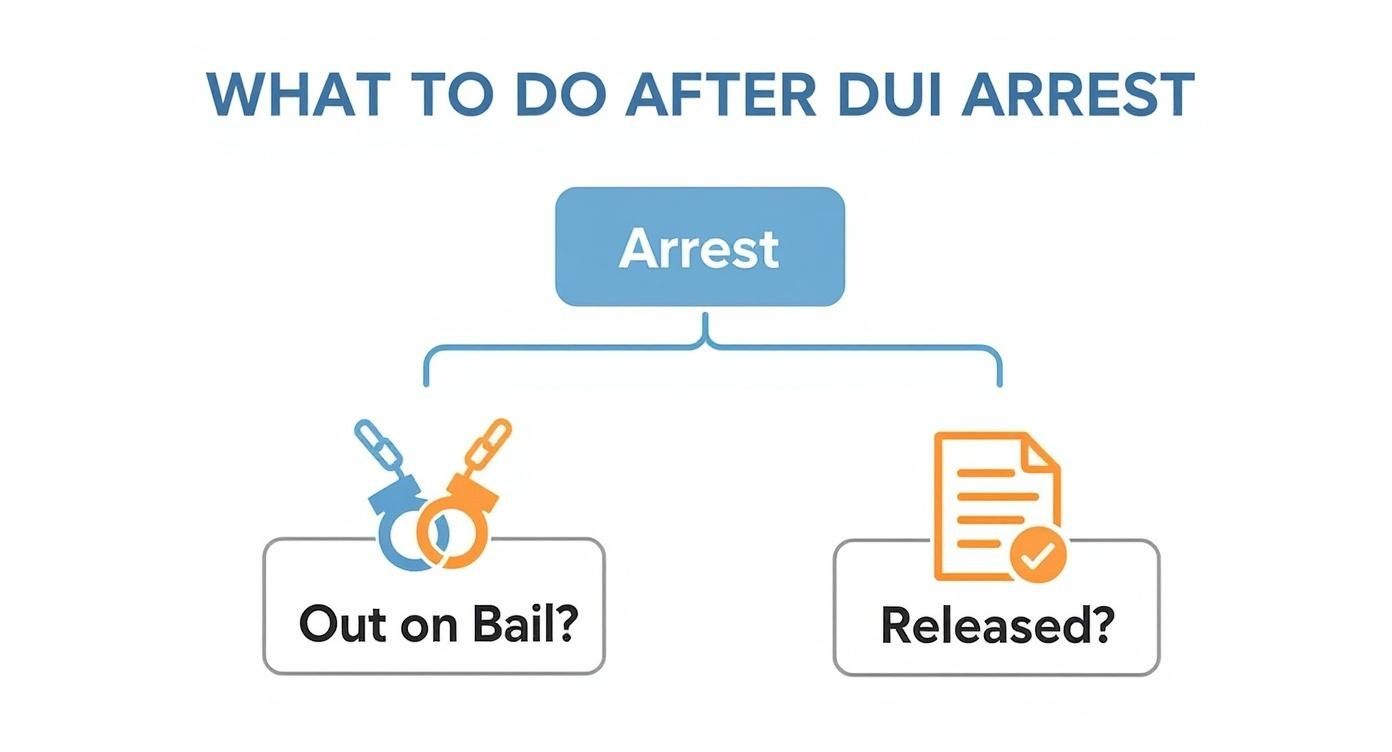
As you can see, what you do in those first few days sets the tone for everything that follows.
Before that 30-day deadline hits, you have two main options to think about:
- File an Administrative License Suspension (ALS) Appeal: This is where you formally challenge the state’s attempt to suspend your license.
- Apply for an Ignition Interlock Device Limited Permit (IIDLP): This option lets you keep driving, but with some very specific restrictions.
Let's unpack what each of these really means for you.
Option 1 The Administrative License Suspension Appeal
Filing an ALS appeal is your chance to request a hearing and fight the automatic license suspension. To get this process started, you must send a request letter to the Georgia Department of Driver Services (DDS) along with a filing fee. It absolutely must be postmarked within 30 days of your arrest.
The ALS hearing is not a trial to determine if you’re guilty of DUI. Its focus is much narrower and is only concerned with whether the arresting officer did their job correctly during the stop.
The hearing officer is only looking at a few key questions:
- Did the officer have reasonable grounds to believe you were driving under the influence?
- Were you properly read Georgia's implied consent notice?
- Did you refuse the chemical test, or did your test show a BAC of 0.08% or higher?
If the officer's actions can be successfully challenged at this hearing, it may be possible to stop the administrative suspension from ever going on your record. You can find more detail about what a license suspension after a DUI looks like and what to expect from the process.
Option 2 The Ignition Interlock Device Permit
The other path is to skip the ALS hearing altogether and instead apply for an Ignition Interlock Device Limited Permit. An IID is a breathalyzer that gets installed in your car. You have to blow into it and provide an alcohol-free breath sample before the engine will start.
To get this permit, you have to meet certain requirements. Typically, it’s only available for a first DUI in five years, and only if you did not refuse the state’s chemical test. The steps involve:
- Surrendering your current Georgia driver's license.
- Paying all the required fees to the DDS.
- Showing proof that you’ve had an IID installed by a state-approved company.
Going the IIDLP route lets you keep driving to essential places like work, school, and medical appointments, so you don’t lose your license completely. But it comes with its own costs—the installation, monthly monitoring fees, and the permit fee itself. It’s important to know this decision is final. Once you choose the IIDLP, you give up your right to an ALS hearing. That’s why making the right call within that initial 30-day window is so critical.
Navigating the Georgia Court Process

After you've dealt with the immediate stress of the arrest and that critical 30-day deadline for your driver's license, the next mountain to climb is the criminal court proceeding. This part of the journey feels overwhelming for most people, but knowing the roadmap makes it far less intimidating.
The Georgia court system has a clear, step-by-step process, starting with your very first appearance.
Your First Court Appearance: The Arraignment
The first time you step inside a courtroom for your case will likely be for the arraignment. This is a formal hearing where the judge officially reads the charges against you and asks you to enter a plea.
At this stage, you typically have three options: guilty, not guilty, or nolo contendere (no contest). It is common for individuals to plead "not guilty" at the arraignment. This isn't an argument on the facts on day one; it's a procedural step that protects constitutional rights and gives a defense representative the time needed to actually investigate the case.
Pleading guilty or no contest right away ends the case quickly, but it means you're accepting all the penalties without ever seeing the evidence against you. A "not guilty" plea simply kicks off the next phase of the process.
What Comes After the Arraignment
Once a "not guilty" plea has been entered, the case moves into a critical phase called discovery. During discovery, the prosecutor is required to hand over all the evidence they've gathered against you. This is the first chance to see what they really have.
That evidence package usually includes things like:
- The arresting officer's official police report.
- Dashcam and bodycam video footage.
- Results from any breath, blood, or urine tests.
- Statements from witnesses and maintenance records for the breathalyzer.
This is where an experienced representative digs in. They're looking for the details that can make or break a case—an incorrectly performed field sobriety test, a contradiction between the video and the written report, or a breathalyzer that wasn't properly calibrated.
Finding these issues allows for the filing of pretrial motions, which are formal arguments asking the court to throw out certain evidence or even dismiss the entire case. These crucial discussions often take place during a preliminary hearing, a step you can learn more about in our detailed guide.
It's important to understand that the system is designed to resolve cases, and not every case goes to a full-blown trial. In fact, the vast majority of DUI cases are resolved through negotiations before a trial ever begins.
Exploring Potential Case Outcomes
How your case unfolds depends on everything from the strength of the evidence and your driving history to the specifics of the traffic stop. For many people, especially first-time offenders, there are several ways a DUI charge can be resolved that don't involve a DUI conviction on your record.
Common Resolutions in Georgia DUI Cases
| Outcome Type | Description | Common Scenario Example |
|---|---|---|
| Plea to a Lesser Charge | The DUI charge is reduced to a less serious offense, like Reckless Driving. This keeps a DUI off the permanent record. | The BAC result was barely over the limit, and there were procedural problems with the traffic stop or sobriety tests. |
| Diversion Program | Usually for first-time offenders, you complete specific requirements (like classes or community service) and the charges are dismissed upon completion. | A young driver with a clean history is arrested with a low BAC. The court offers a path to keep their record clean. |
| Trial (Bench or Jury) | If a fair agreement can't be reached, the case goes to trial. A judge (bench trial) or jury will hear the evidence and decide guilt or innocence. | There are major disputes over the evidence, like a strong challenge to the legality of the initial stop or the accuracy of the chemical test. |
Every case is unique. A charge involving a high BAC and a car accident will be handled very differently from a case where someone refused the breath test and there were no other issues. The most important thing to remember is that you have options. An arrest is just the beginning of the story, not the end.
Understanding the Financial Impact of a DUI

When you're facing a DUI arrest, the first things that come to mind are usually the penalties—jail time, community service, losing your license. But the financial fallout can be just as devastating and often lasts much longer. The total cost of a DUI in Georgia goes way beyond the initial court fine, creating a massive financial weight that can follow you for years.
Right out of the gate, you’re looking at court-imposed fines. For a first-time DUI conviction in Georgia, that number typically falls between $300 and $1,000. And that's before they tack on all the various court surcharges that can easily inflate the final bill. This is just the beginning.
The Hidden Costs Beyond Court Fines
Once the court case is resolved, a whole new wave of expenses hits. These aren't optional; they're mandatory programs and administrative fees you have to pay to satisfy the terms of your sentence and get your life back on track.
You can expect to pay for several required items, each with its own price tag:
- DUI Alcohol or Drug Use Risk Reduction Program: Most people just call this "DUI School." It’s a required 20-hour course that will set you back several hundred dollars.
- Substance Abuse Evaluation: Before you can even sign up for DUI School, you'll have to complete a clinical evaluation, which has its own separate fee.
- Probation Fees: If your sentence includes probation, you'll be paying a monthly supervision fee for up to 12 months or even longer.
Most people don't see these costs coming. A seemingly manageable fine can quickly snowball into a significant financial problem. It's critical to get a clear picture of these obligations early on.
The Long-Term Shock of Insurance Premiums
One of the biggest, longest-lasting financial hits from a DUI comes from your car insurance. A conviction immediately labels you a high-risk driver, and your premiums will go through the roof. After a DUI, it's not uncommon for car insurance rates to jump by an average of 71%. It’s a staggering increase that makes it tough for many people to even afford to drive again.
This isn't just a one-time hike, either. Those inflated rates will likely stick with you for three to five years, sometimes longer, depending on your insurance company. Over time, that adds up to thousands of extra dollars spent just to stay insured. You can learn more about the global context of these laws by reading about the consequences of drunk driving laws on Wikipedia.
To get your license back after a suspension in Georgia, you’ll almost certainly be required to file an SR-22 form with the Department of Driver Services. This isn’t actually insurance—it’s a certificate from your insurer proving you have the state-mandated liability coverage.
Your insurance company will charge you a fee just to file the SR-22, adding another layer of expense and hassle. By understanding this full financial picture—from court fines to probation fees and years of high insurance premiums—you can be better prepared for the road ahead.
The total cost of a DUI can be shocking when you add everything up. Below is a table that breaks down the potential expenses to give you a clearer idea of the financial mountain you might be facing.
Estimated Financial Impact of a First-Time DUI in Georgia
| Expense Category | Typical Cost Range | Important Notes |
|---|---|---|
| Bail/Bond | $150 – $2,500 | Can be higher depending on the county and circumstances. |
| Towing/Impound Fees | $100 – $1,200 | Costs accumulate daily, so retrieving your vehicle quickly is key. |
| Court Fines & Surcharges | $300 – $1,000 | This is the base fine; surcharges can add significantly to the total. |
| Attorney Fees | $2,000 – $10,000+ | Varies widely based on case complexity and representative's experience. |
| DUI School | $360 | State-mandated fee for the 20-hour Risk Reduction Program. |
| Clinical Evaluation | $100 – $300 | A required assessment before you can attend DUI school. |
| Probation Supervision | $400 – $600 | Calculated as a monthly fee (e.g., $35-$50) over a 12-month period. |
| License Reinstatement | $210 – $410 | Depends on the type of suspension and your driving record. |
| Ignition Interlock Device | $700 – $1,500+ | Includes installation and monthly monitoring fees for one year. |
| Insurance Increase (Annual) | $1,500 – $3,000 | This increase can last for 3-5 years, making it the largest long-term cost. |
| SR-22 Filing Fee | $25 – $50 | A one-time fee paid to your insurer to file the certificate. |
| TOTAL ESTIMATED COST | $5,845 – $20,820+ | This range reflects the significant financial burden of a single DUI conviction. |
As you can see, the expenses go far beyond the initial fine. Planning for these costs is an essential part of a strong defense strategy and moving forward after a DUI charge.
Life After a DUI Conviction and Moving Forward
When your court case finally wraps up, it feels like a massive weight has been lifted. But that moment isn't really the end—it's the beginning of a new chapter. Your focus has to shift from the courtroom fight to the practical, real-world tasks of putting your life back together.
Successfully getting through this next phase means knowing exactly what's required of you. From getting your license back to figuring out how this conviction might impact your job, every step has its own set of rules, fees, and deadlines.
Reinstating Your Georgia Driver’s License
For most people, getting back on the road is the number one priority. The path to reinstating your Georgia driver's license isn't automatic; it depends entirely on the terms of your sentence and suspension. You have to take specific, proactive steps to get your driving privileges back.
Typically, the Georgia Department of Driver Services (DDS) will require you to complete a few key tasks before they'll even consider reinstatement:
- Serve the Suspension Period: First things first, you have to wait out the full suspension period. This could be several months or even longer.
- Complete DUI School: You must successfully finish the state-required 20-hour DUI Alcohol or Drug Use Risk Reduction Program.
- Pay Reinstatement Fees: Getting your license back isn't free. Expect to pay fees that can range anywhere from $210 to $410, depending on your specific case.
- Provide Necessary Documentation: You’ll need to turn in proof that you’ve done everything the court ordered, like the certificate from your DUI School.
If you miss any one of these steps, you won’t be driving legally anytime soon. It’s a structured process, and the ball is entirely in your court.
How a DUI Can Affect Your Employment
A DUI conviction can throw a major wrench in your career, especially if you drive for a living. For anyone holding a Commercial Driver's License (CDL), a DUI is often a career-ender due to incredibly strict federal and state rules. But even if you don't drive for work, the consequences can still be serious.
Many employers run background checks, and a DUI can raise red flags in professions that demand a high level of public trust—think teaching, healthcare, or finance. It's smart to get familiar with your company's policies and be ready to have a conversation about what happened.
The reality is that the consequences for driving under the influence in the United States are severe, reflecting the immense danger it poses. In 2023 alone, 12,429 people died in alcohol-impaired driving crashes. Understanding the international context can provide perspective on why these measures are in place. You can learn more about how DUI statistics in the U.S. compare to other countries to see the global scale of this issue.
Exploring Record Restriction in Georgia
One of the most common questions people ask is, "What can I do to clear my record?" In Georgia, the process that used to be called expungement is now known as record restriction. It doesn't erase the arrest, but it does limit who can see it on a background check. Not every DUI conviction is eligible, but there's a chance if your case was dismissed or reduced to a lesser charge.
Figuring out if you're eligible for record restriction is a crucial part of moving forward. It can reopen doors to job and housing opportunities that a conviction might have otherwise closed.
For many, a DUI serves as a wake-up call to re-evaluate their relationship with alcohol. If you're ready to make a positive change, these tips on how to stop drinking alcohol can be a valuable starting point.
Ultimately, finishing all your court-ordered programs, paying off your fines, and completing probation are more than just items on a checklist. They're tangible proof that you're putting this incident behind you and rebuilding your life on a stronger foundation.
Frequently Asked Questions About Georgia DUIs
Getting arrested for a DUI in Georgia is jarring, and it’s natural to have a million questions running through your mind. The path ahead can seem confusing, but getting clear, straight answers is the first step to regaining control. Here are some of the most common questions we hear every day.
Can I Refuse a Breathalyzer Test in Georgia?
Yes, you can refuse the official chemical test at the police station, but that decision comes with immediate and serious consequences. Thanks to Georgia's implied consent law, the act of driving on a public road means you have already agreed to a state-administered test (breath, blood, or urine) if an officer has probable cause for a DUI arrest.
Refusing that test triggers an automatic one-year "hard" suspension of your driver's license. There's no possibility of getting a limited work permit during that year.
It's critical to know the difference between this official test and the small, handheld breathalyzer (Alco-Sensor) an officer might ask you to blow into on the roadside. Refusing that preliminary test does not carry the same automatic license suspension.
How Long Will a DUI Stay on My Record?
A DUI conviction in Georgia is a permanent mark on your criminal history. It never just “falls off” after a few years. While some criminal charges might be eligible for record restriction (what used to be called expungement) if they are dismissed or reduced, a DUI conviction cannot be restricted from your record.
As for your driving record, the Georgia Department of Driver Services (DDS) will see it and use it against you for at least 10 years. This is known as the "lookback period." That means if you get another DUI within that decade, the penalties will be significantly more severe because you'll be treated as a repeat offender.
Do You Go to Jail for a First DUI in Georgia?
Even a first-time DUI in Georgia, which is a misdemeanor, comes with mandatory jail time. A conviction requires you to serve a minimum of 24 hours in jail, though the judge can sentence you to up to one full year.
Now, there is sometimes a bit of flexibility in how that sentence is served. A judge might give you credit for the time you already spent in jail immediately after your arrest, which could satisfy the 24-hour minimum. In some situations, a judge may allow part of a longer jail sentence to be converted to community service, but that is never guaranteed and depends entirely on the court, the prosecutor, and the specific facts of your case.
It's easy to feel overwhelmed when facing a DUI charge, but you don't have to figure out what to do after a DUI by yourself. If you're in Alpharetta, Cumming, or anywhere nearby and have more questions, the team at Brian Hansford Law is here to help. We can give you the clarity and experienced guidance you need. Reach out today to talk about your case by visiting us at challengemycharge.com.
