
Getting pulled over is always a stressful experience. But the one question that really gets your heart pounding is, "Can they search my car?"
The short answer is pretty straightforward: an officer generally needs a warrant, your consent, or what's known as probable cause. Understanding the difference between these is your first line of defense during any traffic stop in Georgia.
Your Rights During a Georgia Traffic Stop
When you're driving through Alpharetta, Cumming, or Johns Creek, your car doesn't have the same level of privacy protection as your home. It’s a critical distinction. While the Fourth Amendment still protects you from unreasonable searches, the courts have carved out something called the "automobile exception."
Think of it as a practical reality. Your house stays put, which gives law enforcement plenty of time to get a warrant. A car, on the other hand, is mobile. Evidence can be driven away in minutes. Because of this, officers have a bit more flexibility to conduct a search without a warrant, but only under very specific and legally defined circumstances.
The Ground Rules for a Vehicle Search
These rules aren't just made up on the fly; they're built on decades of court decisions. The core principle is that any search must be reasonable. A landmark Supreme Court case, Arizona v. Gant, really tightened up the rules, especially for searches that happen right after an arrest. This decision was a big win for drivers, as it prevents officers from conducting overly broad searches that have nothing to do with the reason for the stop.
This decision tree gives you a visual of the basic questions an officer has to run through before searching your vehicle.
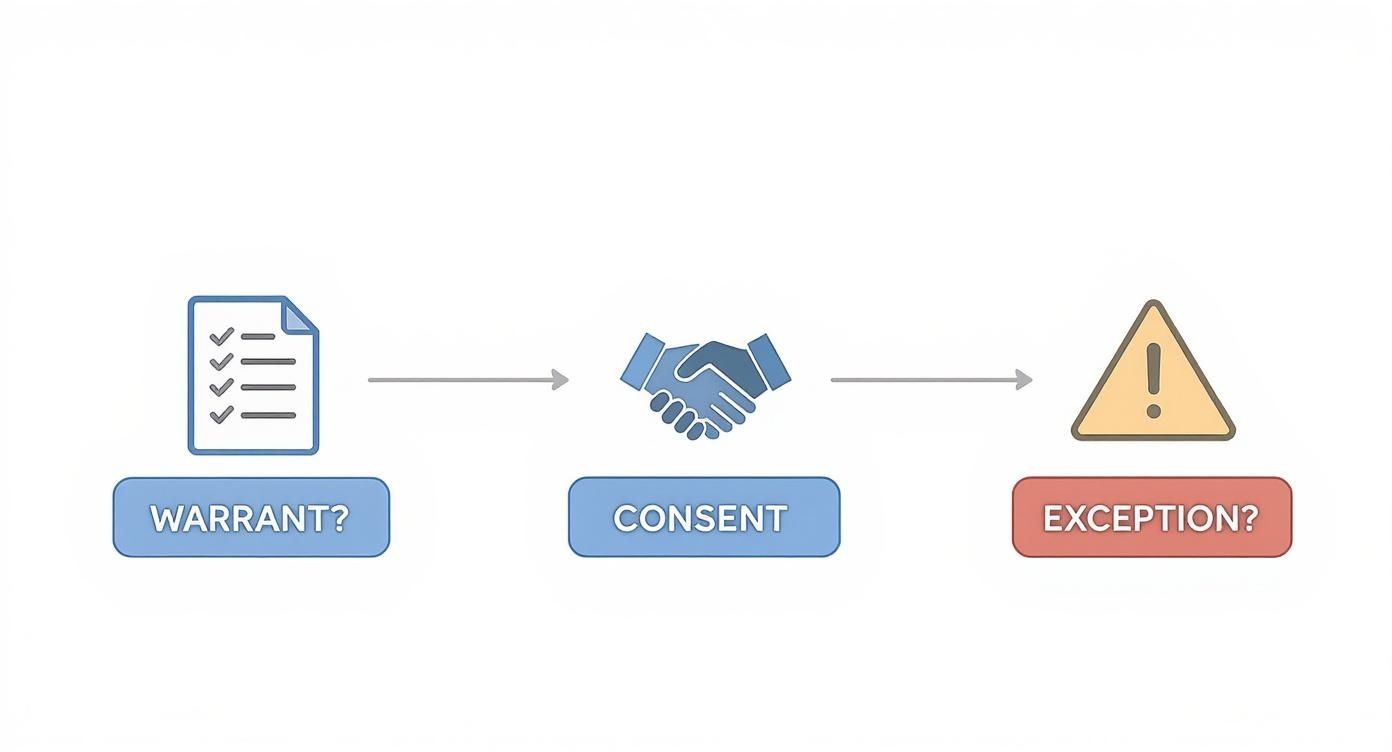
As you can see, the path to a search always starts with a warrant, your consent, or a clear exception to the rule. Each path leads to a very different outcome.
Knowing how to handle yourself calmly during a traffic stop is key. That first interaction really sets the tone for everything that comes next. To prepare, you should understand the typical procedures when you see those blue lights.
At the heart of every traffic stop is the concept of reasonableness. The officer's actions, from the initial stop to any potential search, are measured against what a reasonable person would believe is justified under the circumstances.
This is the foundation of your rights. Whether you’re in Milton, Roswell, or anywhere in Forsyth County, these principles hold true. The officer needs a valid reason to pull you over in the first place, and they can't just decide to search your car unless something new gives them the justification to do so. Understanding this progression from a simple stop to a potential search is the first step in protecting yourself.
Understanding Probable Cause for Vehicle Searches
The most common reason an officer can search your car without a warrant comes down to two words: probable cause. But what does that really mean? It’s not just an officer's hunch or a gut feeling; it’s a standard grounded in specific, observable facts.
Think of probable cause like a collection of puzzle pieces. A single piece might not reveal much, but when an officer puts enough of them together, a clear picture emerges—a reasonable belief that a crime has occurred and that evidence is sitting right there in your vehicle.
This standard is a step below the “beyond a reasonable doubt” required for a conviction in court, but it's a giant leap above a simple suspicion. The officer needs to be able to point to actual facts that would convince a reasonable person that evidence of a crime is likely to be found.
What Does Probable Cause Look Like in Practice?
During a traffic stop in Marietta or anywhere in Cobb County, an officer is trained to observe everything. What starts as a simple stop for speeding can quickly change if they see, hear, or smell something that suggests another crime is afoot.
Here are some real-world examples that can create probable cause on the spot:
- Sight of Contraband: The officer walks up to your window and clearly sees a bag of drugs, an open can of beer, or a firearm sitting on the passenger seat. This is what's known as the "plain view" doctrine.
- Smell of Illegal Substances: In Georgia, the distinct odor of burnt or raw marijuana is still one of the most common reasons officers will search a car.
- Admissions from Anyone in the Car: If an officer asks if there's anything illegal in the vehicle and you or a passenger says "yes," that admission instantly creates probable cause.
- Actions Suggesting Concealment: An officer approaching your car observes passengers frantically shoving something under the seats. These "furtive movements" can be used to build probable cause.
These aren't just vague feelings; they are tangible facts an officer must be able to list in a report and testify to in court. Everything they do is measured against what a reasonable officer would do in the same situation.
Probable cause is not about certainty; it is about probability. The officer doesn't need to be 100% sure there is evidence in the car. They only need a solid, fact-based reason to believe it's probable.
The Automobile Exception Explained
So, why does probable cause let an officer search your car on the side of the road but not your house? This is because of a critical rule known as the “automobile exception.” The reason is simple: mobility. A car can be driven away in minutes, and any evidence inside can disappear with it.
Imagine an officer sees something suspicious through your living room window. In most cases, they must leave, get a warrant signed by a judge, and then come back to search. By contrast, if they develop probable cause during a traffic stop on I-75, the time it takes to get a warrant is a luxury they don't have. The car—and the evidence—could be in the next county by then.
This exception gives law enforcement the power to act immediately when they have probable cause, striking a balance between privacy rights and the practical need to secure evidence. It’s why understanding what constitutes probable cause is so vital for every driver.
Remember, the initial traffic stop itself must be valid. An officer can't just pull you over without a valid reason and go on a "fishing expedition" hoping to find something. If the stop was unlawful from the beginning, any evidence found during the search may get thrown out of court. You can learn more about what makes a stop valid by reading our guide on whether police can stop you for no reason. Knowing your rights starts with understanding the rules of the road—for both you and the police.
The Power of Consent and How to Respond
While probable cause is a powerful tool for law enforcement, one of the most common ways an officer gets inside a vehicle is much simpler: they just ask. This is the power of consent. When you say “yes” to a search, you are voluntarily waiving your Fourth Amendment protections for that specific interaction.
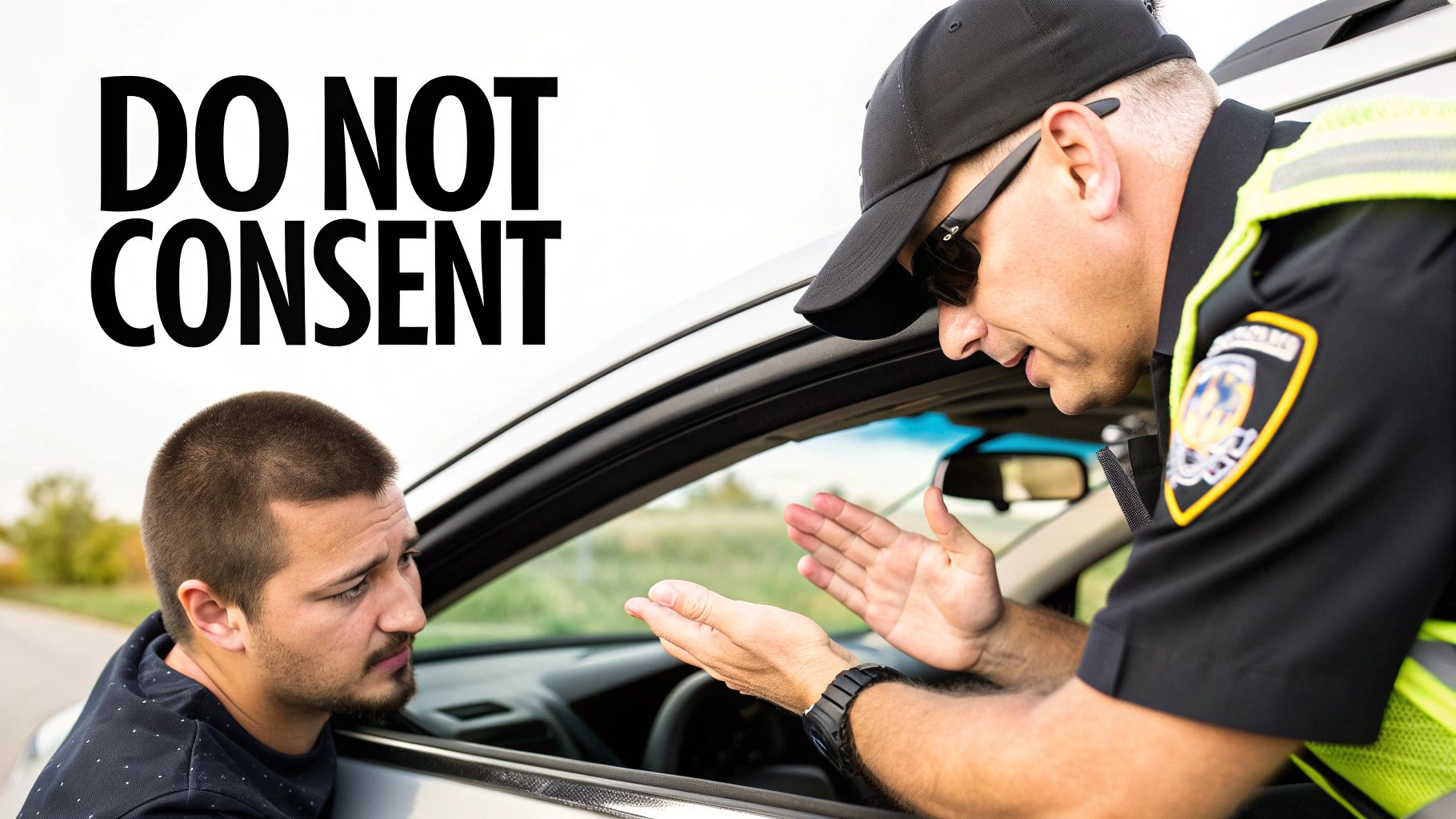
This moment is absolutely critical during any traffic stop. It's easy to feel pressured or intimidated, and many people think they have no real choice but to agree. But the most fundamental thing to understand is that you have the right to say "no." For consent to be valid according to the law, it has to be given freely and voluntarily—it can't be the result of threats or coercion.
Anything an officer finds during a search you agreed to can typically be used as evidence against you. That’s why knowing exactly how to handle this request is one of the most important things any driver can learn.
The Common Scenario: "Do You Mind If I Look Inside?"
Picture this: you're pulled over for a minor traffic violation in Roswell or on GA-400 in Forsyth County. The officer has your license and registration, and everything seems routine. Then comes the question: "You don't have anything illegal in the car, do you? You wouldn't mind if I take a quick look inside?"
This is a request, not a command. The officer is asking for your permission because they almost certainly don't have probable cause to search on their own. What you say next makes all the difference.
You always have the right to decline. Importantly, your refusal to consent cannot be used against you as a reason to establish probable cause. You can be polite and respectful while still being firm.
How to Politely Decline a Search Request
Maintaining a calm, cooperative tone is key, but so is clarity. You don't need to be confrontational or get into an argument. Simple, direct statements are always the most effective.
Here are a few ways to phrase your refusal:
- "Officer, I know you're just doing your job, but I do not consent to any searches."
- "With all due respect, Officer, I am not comfortable with a search, so I do not consent."
- "I would like to exercise my right to refuse this search."
It's best to state your refusal clearly and then remain silent. Avoid the temptation to debate or explain why you are refusing. A simple, unambiguous "no" is your constitutional right.
It is not your responsibility to prove your innocence by allowing a search. The burden is on law enforcement to have a justification to search your vehicle without your permission.
Understanding the Scope of Your Consent
Even if you do decide to give consent, it's crucial to understand its limits. You can control the scope of the search. For example, if you say, "You can look on the front seat," that permission doesn't automatically extend to a locked glove box or the trunk.
However, if you give a vague, general "yes" to a search request, it can be interpreted as permission to search the entire vehicle, including locked containers inside. This ambiguity often works in the officer's favor. That’s why being specific—or better yet, declining the search entirely—provides the clearest protection for your rights.
And remember, you can change your mind. Once you give consent, you can also revoke it at any time. Just state clearly, "Officer, I am revoking my consent to search." While anything found before you revoke it can still be used, stopping the search can prevent them from finding anything else.
Beyond Warrants: More Reasons Police Can Search Your Car
Probable cause and consent are the two main roads police travel down to search a vehicle, but they aren't the only ones. The law recognizes a few other well-established exceptions that allow an officer to conduct a search without getting a warrant first. Understanding these scenarios is key to knowing your rights during a traffic stop in Cumming, Roswell, or anywhere else in North Georgia.
These aren't just loopholes; they are specific rules courts have carved out to deal with the fast-moving reality of policing on the streets. Each one comes with its own justification and, just as importantly, its own set of limits. Let's break down three of the most common exceptions you might run into: Plain View, Search Incident to Arrest, and Inventory Searches.
The Plain View Doctrine
This one is about as straightforward as it gets. The Plain View Doctrine allows an officer to seize any item they believe is evidence of a crime without a warrant, as long as two basic conditions are met:
- The officer has a valid right to be where they are when they see the item.
- The illegal nature of the item is immediately obvious just by looking at it.
Picture this: you get pulled over for a broken taillight on a road in East Cobb. The officer is standing next to your car to talk to you. If they shine their flashlight inside and see a bag of what is clearly marijuana sitting on your passenger seat, they don't need to call a judge for a warrant. The evidence is in plain view, and they have the right to seize it.
From there, finding that bag of marijuana can easily give them the probable cause they need to search the rest of your vehicle. What begins with a simple look through the window can escalate quickly.
Search Incident to a Lawful Arrest
Another frequent reason for a search happens right after you or a passenger is formally arrested. This is called a search incident to arrest. The courts allow this type of search for two main reasons: to ensure officer safety by finding any weapons and to prevent the person being arrested from destroying evidence.
However, this is not an open invitation for officers to tear your car apart. The Supreme Court has put real limits on these searches. An officer can generally only search the person they arrested and the area within that person's "immediate control." In a car, that usually means the passenger compartment area where the person could have reached for a weapon or ditched evidence right before being arrested.
For instance, if you're arrested for DUI in Forsyth County and handcuffed in the back of a patrol car, an officer might be able to search the driver's seat area. But that exception almost certainly wouldn't let them pop open and search a locked trunk, since you couldn't possibly reach it at that point.
The goal of a search incident to arrest is very specific: disarm the suspect and preserve evidence related to that particular arrest. It’s not supposed to be a "fishing expedition" for unrelated crimes.
Inventory Searches Before Your Car Is Towed
Finally, if your vehicle is being impounded after an arrest or a major accident, the police will perform an inventory search. The official reason for this search isn't to look for evidence, but simply to catalogue everything inside the car.
This procedure serves three administrative goals:
- To protect your property while the car is in police custody.
- To protect the police department from false claims of lost or stolen items.
- To protect officers from anything dangerous that might be hidden in the car.
Because this is considered an administrative task, not a criminal investigation, police don't need a warrant or probable cause. They're just following department policy. But make no mistake—if they stumble across illegal drugs, weapons, or other contraband during this routine inventory, that evidence can absolutely be used to charge you with a crime.
The rules governing these searches come from a tangled web of court cases and laws that have evolved over decades. Research from The Stanford Open Policing Project shows how these rules play out on the road, revealing that Black and Hispanic drivers are searched far more often than white drivers. You can dig into the data and learn more about their findings on policing patterns. For every driver, understanding these exceptions isn't just academic—it's essential.
How to Handle a Traffic Stop and Search Request
It's one thing to understand the rules on vehicle searches from the comfort of your home, but it's another thing entirely to keep your composure and assert your rights with flashing blue lights in your rearview mirror. When an officer asks to search your car, having a clear plan is critical. This guide is your mental script for protecting your rights without making the situation worse.

As soon as you see the lights, pull over to a safe spot. Turn off your engine, turn on the interior dome light if it's dark out, and place both hands on the steering wheel where the officer can see them. These simple steps show you're cooperative and can help lower any tension right from the start.
Your Initial Actions and Words
The officer will approach your window and ask for your license, registration, and insurance. Have them ready and provide them politely. Cooperating with these lawful requests is always the right move.
After you've handed over your documents, the conversation might shift. The officer may ask where you're coming from, where you're headed, or if you know why they pulled you over. You are not required to answer these questions. You have the right to remain silent, and it's usually smart to use it. Anything you say, even if it seems harmless, can be used against you.
How to Clearly Refuse a Search Request
This is the make-or-break moment. If the officer asks for permission to search your car, your answer needs to be crystal clear. The fact that they are asking is a strong signal that they probably don't have probable cause.
Keep it simple and respectful. You don't need to get into a debate or give a long explanation.
- “Officer, I respect that you have a job to do, but I do not consent to any searches.”
- “I am not comfortable with a search, so I am not giving my consent.”
- “I would like to exercise my Fourth Amendment right to refuse this search.”
Once you've said no, the best thing to do is remain silent. Don't feel pressured to justify your decision. A clear refusal cannot be used as the basis to search your car.
The goal is to be polite but firm. You are not being difficult; you are simply exercising a fundamental right. A calm and clear "no" is your most powerful tool in this situation.
If the Officer Searches Anyway
Sometimes, an officer will claim they have probable cause and search your vehicle even after you've refused consent. If this happens, it is absolutely critical that you do not physically resist. Do not get in their way, argue, or try to stop them.
While you should never resist, you can—and should—restate your position for the record. Say something like, “Officer, I want to be clear that while I am not resisting, this search is happening without my consent.”
At this point, your job changes. You are no longer trying to prevent the search; you are now a witness. Pay close attention to everything. Note what the officer says, exactly where they search, and what they look at. If other officers are there, take note of them, too. This information could be the key to getting any illegally found evidence thrown out of court.
What Happens After an Unlawful Vehicle Search
Understanding your rights on the side of the road is one thing, but what happens when an officer crosses the line and conducts an improper search anyway? The interaction doesn't just end there. The justice system actually has a powerful tool to deal with violations of your Fourth Amendment rights.
This safeguard is called the exclusionary rule. Put simply, it means that the prosecution can’t use improperly obtained evidence against you. If a court decides a search was unlawful, anything the police found—no matter how damaging it seems—gets thrown out. It's considered “fruit of the poisonous tree.”
Challenging the Evidence with a Motion to Suppress
A motion to suppress evidence is a formal request filed with the court, asking the judge to block the state from using that improperly gathered evidence at trial. Filing this motion triggers a critical hearing where a judge will scrutinize every single detail of the traffic stop and the search that followed.
The court will dig into the key questions:
- Was the initial traffic stop in Cumming or Roswell justified in the first place?
- Did the officer have genuine probable cause for the search, or was it just a hunch?
- If you supposedly gave consent, was it truly voluntary, or were you pressured into it?
Every word and action from the moment those blue lights flashed on becomes evidence. The officer’s stated reason for the search will be put under a microscope. If their justification doesn't hold up to the strict standards of the Fourth Amendment, the evidence they found can be suppressed. You can discover more about how the exclusionary rule works and the major impact it can have on a criminal case.
Unfortunately, the grounds for a vehicle search aren't always applied fairly. A 2022 national survey revealed that 9% of Black drivers were searched during traffic stops, compared to only 4% of Hispanic drivers and 3% of white drivers. This disparity is even more stark when you see that contraband was actually found more often in searches of white drivers (18.2%) than in searches of Black (13.9%) or Hispanic (11.0%) drivers. You can explore the full dataset and read the detailed research on traffic stop disparities.
This is exactly why knowing and defending your rights is so critical. A successful motion to suppress can completely change the direction of a case. Without their key evidence, the prosecution’s case can quickly fall apart, often leading to reduced charges or even a complete dismissal.
This process shows how an experienced defense attorney can attack the very foundation of the state's case. It turns that roadside encounter into a battleground where constitutional principles are upheld, ensuring that a violation of your rights has real, tangible consequences in the courtroom.
Common Questions About Georgia Vehicle Searches
When you're pulled over, things can get confusing fast. The law isn't always straightforward, and drivers often have the same practical questions. Here are some clear answers to the things we get asked about most.
Can Police Search My Trunk Or A Locked Glove Box?
This really depends on why the officer is searching in the first place. If an officer has probable cause to believe evidence is in a specific spot, like your trunk, the automobile exception usually lets them search it without a warrant.
But what if you give consent? The scope of your permission is critical. A simple "yes" to a search could be interpreted by an officer as permission to look everywhere. You are allowed to limit your consent. For example, you can say, "You can look in the passenger area, but not my trunk." Keep in mind, if your car is being impounded, police will conduct an inventory search and they will go through everything, including locked compartments.
The rule of thumb is that the scope of the search has to match the reason for it. An officer having probable cause to believe there are drugs in the passenger seat doesn't automatically give them the right to break open a locked suitcase in the trunk.
What If My Passenger Has Something Illegal?
This is a tricky situation that can drag innocent people into serious trouble. If the police establish probable cause to search the car, they can typically search any area where the illegal item could reasonably be hidden. If they find contraband in a shared space, like the center console or on the floorboard, everyone in the car could potentially be charged under a concept called "constructive possession."
If the item is found on your passenger's person, they will likely be the only one charged. But never assume you're safe just because the contraband isn't yours.
Is The Smell Of Marijuana Still Probable Cause In Georgia?
Yes, it absolutely is. While laws around the country are changing, marijuana is still illegal for recreational use here in Georgia. Because of that, the distinct smell of either burnt or raw marijuana is still considered probable cause for an officer to believe a crime is happening.
This is one of the most common reasons a routine traffic stop in places like Alpharetta or Cobb County escalates into a full-blown vehicle search, giving the officer the authority they need to search your car without a warrant.
If you are facing charges after a vehicle search in Alpharetta, Cumming, Johns Creek, or the surrounding areas, the details of that stop matter immensely. At Brian Hansford Law, we scrutinize every aspect of the police encounter to protect your rights. For a dedicated defense that challenges unlawful searches, contact us today.
