
A lot of people call a lawyer only after the panic sets in. The case looked finished. Maybe the charge was dismissed in Alpharetta Municipal Court. Maybe a jury in Cobb County didn't convict. Maybe the state backed off after a weak stop, a bad breath test, or a witness who didn't show. Then a new court date arrives, or a new agency starts a separate proceeding, and the question comes fast.
Can they really charge me again?
Sometimes the answer is no. But when does double jeopardy not apply? More often than people expect. That surprise is what makes this issue dangerous in DUI cases, drug cases, traffic cases, and more serious felony matters across North Atlanta. The common understanding of "double jeopardy" is a broad sense of fairness. What the law protects is narrower, and the exceptions matter.
If you're dealing with a second prosecution, a refiling, a hung jury, a state case that may draw federal attention, or a DUI arrest that triggered both court and license problems, the details control everything. The timing matters. The court matters. The type of proceeding matters. So does who is prosecuting the case.
You Thought It Was Over But Now You're Being Charged Again
A common version of this starts with relief.
Someone gets arrested in Cumming for DUI, reckless driving, or drug possession. They hire counsel, go to court, and hear that the charge was dismissed or that the case didn't end in a conviction. Families exhale. Work can continue. License worries ease up for a moment. Then a letter arrives, or a warrant issue surfaces, or the prosecutor announces the case is coming back.

That shock is understandable because double jeopardy is often understood to mean one chance only. If the government tried once, that's it. If the case fell apart, that's over. If there was an early win, no one can touch it again.
That's not how this works.
Why this catches people off guard
The Fifth Amendment protects against being tried twice for the same offense, but that protection has limits. It doesn't start at arrest. It doesn't block every refiling. It doesn't stop every retrial. And it doesn't always prevent a federal case after a state case.
In North Atlanta courts, that becomes very real in cases involving:
- DUI and traffic offenses: A dismissal or mistrial doesn't always end the risk.
- Drug cases: State charges can create federal exposure if the facts also fit federal law.
- License matters: Administrative action can move forward even while the criminal case is separate.
- Felony prosecutions: A procedural win may still leave the door open for another round.
Practical rule: If you've received notice of a new hearing, a refiled accusation, or contact from another prosecuting agency, don't assume "double jeopardy" fixes it. Have someone check whether jeopardy ever attached, whether the first case ended with a final verdict, and whether a different sovereign is involved.
The mistake that hurts defendants most
The biggest mistake is waiting because you think the Constitution automatically bars the new case. Deadlines keep moving while that assumption sits there. Witnesses disappear. Court dates pass. Administrative deadlines in DUI matters don't pause just because the criminal side feels confusing.
A second charge can be beatable. But it has to be analyzed quickly and with precision.
Understanding The Rule The Moment Jeopardy Attaches
Double jeopardy starts with the Fifth Amendment. Its core purpose is straightforward. The government doesn't get unlimited attempts to convict you for the same offense after a true acquittal or conviction.
The hard part is figuring out when the protection begins. In everyday conversation, people think it starts with arrest or with the first court date. Legally, that's wrong.

The moment that matters
In a jury trial, jeopardy attaches when the jury is empaneled and sworn. In a bench trial, it attaches when the first witness is sworn. That rule is described in Cornell's explanation of double jeopardy, which also notes Serfass v. United States (1976). The same source states that about 18% of federal criminal cases, approximately 15,000 annually, involve pre-attachment dismissals refiled without a double jeopardy bar.
That one timing rule explains why so many people are surprised by refilings.
If a prosecutor dismisses a case before jeopardy attaches, the state often can bring it back. If a municipal or state court matter in Roswell or Marietta is dropped early because of a paperwork defect, a missing officer, or another pretrial problem, the defense still has to ask the next question. Was this a final end to the case, or just a pause before refiling?
For a more detailed breakdown of the doctrine itself, see this double jeopardy legal definition.
What doesn't trigger protection
A lot happens before attachment, and none of it automatically gives you a double jeopardy shield.
- Arrest: Being handcuffed or booked doesn't trigger it.
- Bond hearing: Important, but not the attachment point.
- Preliminary motions: Even strong motions can end a case early without creating a jeopardy bar.
- Early dismissal: If it happens before attachment, prosecutors may have room to refile.
How this plays out in local courts
Take a DUI case in Cobb County State Court. If the case is called and reset several times, the defendant may feel dragged through the system, but double jeopardy hasn't attached just because the case has been pending for months. If the state dismisses before trial starts, it may still come back.
The same is true in many misdemeanor and traffic cases in Alpharetta and Cumming. An early courtroom win is valuable. It can provide an advantage, expose weaknesses, and sometimes end the matter for good. But unless the case reached the attachment point and then ended in a way the law treats as final, the analysis isn't finished.
What matters isn't whether the process felt serious. What matters is whether the law says jeopardy attached and whether the first case ended with finality.
What actually works
When clients ask when does double jeopardy not apply, the most useful answer starts with paperwork and timing, not slogans.
A strong defense looks at:
- The exact procedural posture of the first case.
- Whether a jury was sworn or, in a bench trial, whether testimony began.
- How the first matter ended, including dismissal language and court orders.
- Whether the new filing alleges the same offense or a legally distinct one.
That analysis often decides whether the second prosecution is barred, negotiable, or fully allowed.
The Separate Sovereigns Exception State vs Federal Charges
The biggest exception is often unforeseen. State and federal prosecutors can sometimes bring separate cases based on the same conduct.
That rule is called the dual sovereignty doctrine. The doctrine was established by the U.S. Supreme Court in 1922, and the ACLU's discussion of the issue explains that it allows separate state and federal prosecutions for the same offense under different sovereigns. The same discussion points to the Rodney King prosecutions, where officers acquitted in state court were later convicted in federal court for violating civil rights. See the ACLU's analysis in its discussion of the dual sovereignty loophole.

Why the same conduct can produce two prosecutions
This feels unfair to many defendants because the conduct is the same. But the law doesn't always ask only whether the act was the same. It also asks whose law was violated.
Georgia is one sovereign. The United States is another. If the same conduct violates both Georgia criminal law and a federal statute, each sovereign can claim an independent interest in prosecuting it.
That matters far more in some cases than others.
Where North Atlanta defendants face this risk
For many routine speeding tickets or low-level municipal matters, federal exposure isn't the concern. But in these categories, it can become very real:
- Drug trafficking allegations: Especially where facts suggest interstate movement, larger distribution patterns, or federal controlled substance violations.
- Firearm cases: Some possession charges can trigger separate federal attention.
- White-collar allegations: Fraud, wire communications, and interstate financial conduct can quickly alter the legal circumstances.
- Civil rights or public corruption cases: Those can invite federal review even after state proceedings.
A person in Alpharetta, Cumming, or Marietta can beat or resolve a Georgia case and still face federal scrutiny if the facts fit a federal offense. That's why a narrow courtroom win at the state level doesn't always mean the danger is gone.
What works and what doesn't
What doesn't work is assuming a not guilty verdict in state court automatically blocks every future case. It may block another prosecution by the same sovereign for the same offense. It does not automatically block federal action.
What does work is recognizing the risk early and defending with the bigger picture in mind.
That means looking at:
- Whether the evidence suggests interstate conduct
- Whether federal agents are already involved
- Whether seized evidence could support a parallel federal charge
- Whether plea strategy on the state side could affect later exposure
A state case can be the visible part of the problem. The smarter defense asks whether another prosecutor is waiting outside the frame.
A practical local example
Suppose someone in Forsyth County is arrested on a drug distribution allegation. The state case focuses on Georgia charges. The defense may challenge the stop, the search, the chain of custody, and witness reliability. All of that matters.
But if the investigation also involves interstate communications, broader distribution allegations, or evidence that fits federal statutes, the legal risk isn't limited to the county courthouse. In that setting, the phrase "same conduct" doesn't end the discussion.
The client question that matters most
The question isn't just "Can they do that?" Sometimes they can.
The better question is, who can still charge me, based on what facts, and what decisions made now could make that better or worse later? In a serious drug or felony case, that's the level the defense has to operate on from the beginning.
When a Trial Ends Without a Final Verdict
Some cases don't end cleanly. No acquittal. No conviction that stays in place. No true final judgment. In those situations, double jeopardy often doesn't block another trial.
The most common example is a hung jury. Jurors deliberate and can't reach a unanimous verdict. The judge declares a mistrial. That result is frustrating for everyone, but it usually doesn't count as an acquittal.
Hung juries and continued jeopardy
A discussion of this issue at Werksman Jackson's double jeopardy analysis explains that U.S. federal courts declare hung juries in approximately 5-6% of criminal trials annually. The same source notes United States v. Perez (1824), which treated a mistrial from a hung jury as leaving the defendant in continued jeopardy, allowing retrial. It also states that retrials after hung juries in federal cases result in a 77% conviction rate.
That last number matters because people often mistake a mistrial for a defense win. Sometimes it is a strategic improvement. It may show that the prosecution couldn't persuade a full jury. It may reveal major credibility problems. But it is not final.
What that means in practice
In a Forsyth County DUI trial, jurors may split over field sobriety tests, body camera footage, or whether the driving showed impairment. In a Cobb County theft or drug case, one juror may hold out while others push to convict. If the jury can't reach a lawful verdict, the state may try again with a new jury.
That changes defense strategy immediately.
After a mistrial, the prosecution knows more than it knew the first time. Prosecutors often refine witness preparation, tighten exhibits, and adjust arguments based on what failed before. Defense counsel has to do the same, and often faster.
For context on bad-faith behavior that can affect retrial analysis, this overview of what counts as prosecutorial misconduct is worth reviewing.
Defense view: A mistrial is not closure. It's a reset with more information on both sides.
Appeals don't always end the case either
Clients are often shocked by this part. If a defendant appeals a conviction and wins, that doesn't always mean the case disappears. In many situations, it means the conviction is reversed and the case goes back for another trial.
Why? Because the successful appeal may have established that something went wrong in the first trial, not that the evidence was legally insufficient to prosecute at all. A bad evidentiary ruling, a flawed jury instruction, or another trial error can lead to a new trial rather than a dismissal.
The real trade-off after a mistrial or reversal
After a hung jury or successful appeal, every option has to be reconsidered.
- Retry the case: Sometimes the defense likes the first jury split and wants another shot.
- Negotiate from strength: A mistrial can expose serious weakness in the state's proof.
- Push dismissal arguments: If the prosecution's case depends on a witness who is fading or unavailable, timing may help the defense.
- Prepare for a harder second fight: The state gets to learn from round one too.
What works is a hard-eyed review of the first proceeding. Juror reaction, witness performance, evidentiary rulings, and the prosecutor's theory all matter. What doesn't work is treating the mistrial as if the Constitution already finished the job.
Different Crimes from the Same Act and Civil Penalties
One event can lead to more than one charge. That alone doesn't create a double jeopardy problem.
The legal question is whether those charges are the same offense. Under the Blockburger test, they are not the same if each statute requires proof of an element the other does not. A discussion at Liberty Justice Legal on double jeopardy protections explains that Blockburger v. United States (1932) defines the rule this way and that Gamble v. United States (2019) reaffirmed it. The same source states that over 12,000 dual-sovereignty cases were processed annually before 2020.
One stop, multiple charges
This comes up all the time in traffic and criminal practice.
A Roswell traffic stop might lead to allegations of DUI, reckless driving, and speeding. Those charges may all come from the same driving event, but they are not automatically the same offense for double jeopardy purposes. Each offense can require proof of something different.
The same pattern shows up in drug cases and assault cases. One incident can produce several counts, and the Constitution doesn't erase separate charges just because they arose from one evening or one police encounter.
Common exceptions at a glance
| Exception | What It Means | Example |
|---|---|---|
| Separate sovereigns | State and federal governments may each prosecute conduct that violates their own laws | A Georgia drug case followed by a federal drug prosecution based on the same conduct |
| Hung jury mistrial | No final verdict was reached, so retrial may be allowed | A Forsyth County jury can't agree in a DUI case |
| Pre-attachment dismissal | If jeopardy never attached, prosecutors may refile | Charges dismissed before a jury is sworn |
| Different offenses from the same act | Multiple charges can stand if each requires different proof | DUI and reckless driving from one traffic stop |
| Civil or administrative proceedings | Double jeopardy applies to criminal prosecutions, not every consequence tied to the event | License suspension proceeding after a DUI arrest |
Criminal punishment is not the same as civil or administrative action
DUI defendants in Georgia often get tripped up.
Double jeopardy protects against certain repeated criminal prosecutions. It does not mean every consequence tied to the incident must disappear if one part of the case goes well. A person can face a criminal prosecution in court and also deal with a separate administrative license issue. A person can be acquitted criminally and still face a civil claim from the same event.
That distinction matters for professionals, parents, and anyone whose ability to drive keeps the household moving.
The same event can create three different fights. Criminal court, an agency proceeding, and a civil claim. Winning one does not automatically win the others.
Why this matters in serious immigration-sensitive cases
For some defendants, the question isn't only jail or probation. It's also immigration exposure, licensing consequences, and future employability. In those cases, the defense has to think beyond the criminal caption on the court calendar.
This is especially true where a plea to one count may look narrow in criminal court but create a different kind of problem elsewhere. Anyone worried about that overlap should understand issues like how DUI charges can affect immigration status.
What actually helps
The best defense approach is offense-by-offense. Read the charging documents closely. Compare the legal elements. Identify whether a second charge is duplicative or merely related. Then separate criminal exposure from administrative and civil fallout.
What doesn't help is arguing, in general terms, that "it all came from the same stop." Sometimes that's emotionally persuasive. Legally, it often isn't enough.
Georgia's Rules DUI License Suspensions and Local Courts
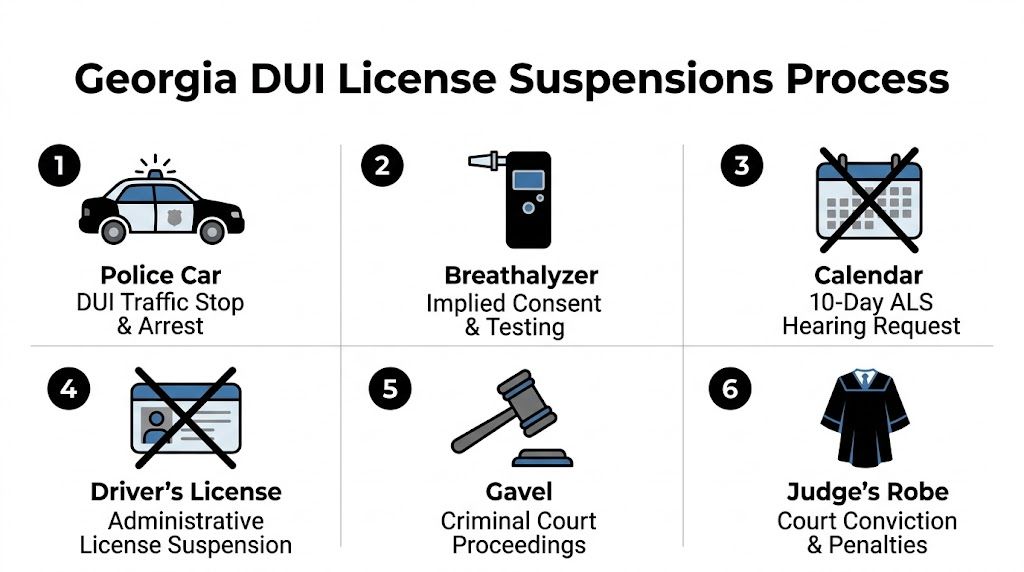
DUI cases create some of the worst double jeopardy confusion in Georgia because there are usually two separate fights happening at once. One is the criminal case. The other is the driver's license problem.
Those are not the same proceeding.
The DUI case and the license case move on different tracks
A discussion at Rendelman Law about why double jeopardy doesn't apply in these settings explains that in Georgia, O.C.G.A. § 40-5-67 mandates administrative hearings after a DUI arrest, and those hearings are separate from criminal trials and do not trigger double jeopardy protections. The same source states that in 2025, 15% of DUI cases, over 12,000, in metro areas like Roswell and Marietta involved mistrials or dismissals that led to re-prosecutions.
This is the local reality many drivers in Alpharetta, Cumming, Johns Creek, and Marietta don't expect. They think beating the criminal case automatically saves the license, or that resolving the license issue ends the criminal risk. Neither assumption is safe.
What this means after a North Atlanta DUI arrest
If you're arrested for DUI in Georgia, you may be dealing with:
- An administrative license suspension issue: This concerns your privilege to drive.
- A criminal prosecution: This concerns guilt, penalties, and a criminal record.
- Possible related traffic charges: Reckless driving, speeding, open container, or other offenses may travel with the DUI.
A favorable development in one lane doesn't automatically control the others.
For example, a license hearing is not the same thing as a jury trial in a county court. A dismissal in one courtroom may still leave the agency matter alive. A procedural issue in the agency setting may not destroy the prosecutor's criminal case.
Why local court knowledge matters
DUI practice in Fulton County, Forsyth County, Cobb County, and Gwinnett County isn't just about statutes. It's about timing, judges, calendars, officer appearance issues, discovery habits, and how local prosecutors respond after a weak first attempt.
In some courts, the main battle early on is preserving the right to drive. In others, the defense may focus first on the stop, testing procedure, or suppression issues. In still others, the practical question is whether the state can prove impairment cleanly enough to survive trial.
That is why generic advice fails people. A DUI attorney handling North Atlanta cases has to think about the agency process, the criminal file, and the local courtroom culture at the same time.
If you treat a Georgia DUI as only one case, you're already behind. It is usually at least two separate problems moving on separate timelines.
What works for defendants and what doesn't
What works:
- Acting immediately after arrest. Delay is the enemy in license matters.
- Separating the proceedings in your mind. Court and license consequences are connected, but they are not the same.
- Reviewing the stop and test process early. Weaknesses there can shape both tracks.
- Preparing for refiling risk if the first court result isn't final.
What doesn't work:
- Assuming an administrative result ends the criminal case.
- Assuming a dismissal before trial means the state can never come back.
- Treating a DUI like a simple traffic ticket.
- Waiting until the next court date to ask license questions.
The bottom line for local drivers
When people ask when does double jeopardy not apply in Georgia DUI cases, the answer often begins with this: it doesn't stop separate administrative license proceedings, and it doesn't always stop a reprosecution after a mistrial or nonfinal dismissal.
That is why DUI defense in North Atlanta has to be practical, local, and fast.
Facing a Second Charge? You Need an Aggressive Defense Now
A second charge feels personal. It's often perceived as harassment. Sometimes that's close to the truth. Other times it's a lawful refiling, a retrial after a mistrial, a separate administrative action, or a different sovereign stepping in. The Constitution may still protect you, but only if the facts fit the rule.
That is why broad assumptions are dangerous.
If your case was dismissed in Alpharetta, if your DUI in Cumming ended without a verdict, if your drug case in Cobb County raises federal concerns, or if your license is under attack while your criminal case is still pending, the question isn't whether the situation feels unfair. The question is whether the new action is legally barred, strategically beatable, or something that demands immediate damage control.
The first moves matter
A strong response usually starts with a focused review of the record:
- How did the first case end
- Did jeopardy attach
- Is the new matter criminal, administrative, or federal
- Are the new charges the same offense or legally distinct
- Did prosecutorial conduct create any bar to a retrial
Those are not academic questions. They shape whether the defense files a motion to dismiss, prepares for a second trial, opens negotiations, or shifts strategy because the main threat now sits in another court.
Don't rely on common-sense double jeopardy
Common sense says one case should mean one shot. Real criminal practice is narrower and harsher than that. The legal system allows exceptions, and prosecutors use them. Defendants need to be ready for that.
If you're facing a second prosecution, a DUI refiling, a license suspension issue, or a state case with possible federal overlap, get the file reviewed immediately. Delay helps the other side. A fast, informed defense protects options.
If you're dealing with a second charge, a refiled DUI, a traffic case that won't stay dismissed, or a state case that may draw federal attention, Brian Hansford Law can review the procedural history, identify whether double jeopardy applies, and move quickly to protect your rights. Brian Hansford brings over 25 years of experience, including work as a former prosecutor, and represents clients across Alpharetta, Cumming, Johns Creek, Milton, Roswell, Marietta, Forsyth County, East Cobb, and Cobb County. Reach out for a free consultation if you need same-day guidance on court deadlines, license protection, or a strategy to fight the next move before it gains momentum.
